Grief Song
Joy Harjo reckons with the death of her daughter in Cloud Runner
Cloud Runner by Joy Harjo reminds us that while the only devastating constant in life is grief, poetry and its music can do some of the heavy carrying. In her 12th poetry collection, written in the wake of her daughter Rainy Dawn Ortiz’s 2023 death, the three-term U.S. Poet Laureate invites readers into the complex stages of mourning.

Cloud Runner moves through poems of rage, memory, and hope, reflecting the nonlinear nature of grief. An artist and writer of the Muscogee (Creek) Nation, Harjo explores the intersections of personal history and ancestral memory throughout her canon of multidisciplinary work. In Cloud Runner, these connections weave through a loss Harjo describes as beyond words.
Harjo begins with the aptly titled “This Is Not a Poem, It Is a Cry.” Rejecting the familiar poetry adage of “tell it slant,” Harjo speaks directly in brief, punctuated lines, conveying emotion metaphor cannot capture: “It has been four days. / I have lost my girl. / Some things do not belong in words.”
Although Harjo’s intention is to call hope into the conversation eventually, she makes no attempt to rush the process. Instead, she establishes a crucial truth: We cannot hurry or deny the existence of grief. Throughout Cloud Runner, Harjo explores death as a force that doesn’t just devastate; it navigates her closer to other relationships, whether Earth-side or in ancestral memory. Her poems draw on history, myth, violence, and song in italicized postludes seemingly addressed to her daughter, creating a second narrative through which these memories and myths can speak. In the opening poem, the directness gives way to a more mystical tone: “It was a waning moon / the night your last breath circled us then / flew out to join the ancestor breathing.”
Both narratives inform Cloud Runner’s expansive understanding of connection and intensify the tender, frank addresses of motherhood. Before the first poem, an epigraph by writer and educator Katie Bickham establishes the collection’s central bodily metaphor: “Grief is like contractions, but in reverse.” The comparison brings the process of mourning into the body. Harjo bridges the pain of losing a child and bringing one into the world. She writes, “When you were born poetry began in me.” Here, Harjo identifies motherhood not only in the body, but in the creative life that emerges through the relationship. In “The Sacred Art of Mothering,” the declaration continues, “The mother root is the deepest,” bringing into conversation a deep connectedness to nature and a bond beyond the visible world.
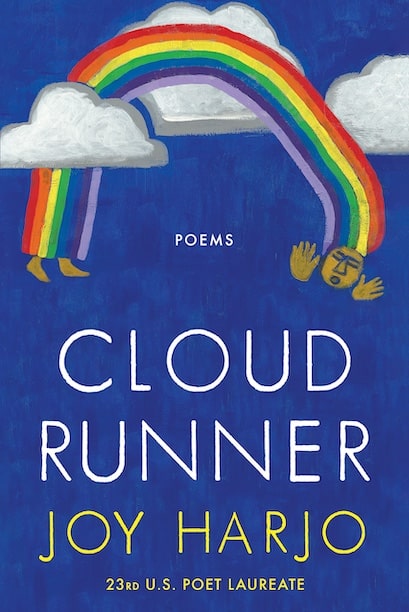 Music and visual art lie at the heart of this expanded connectedness. Harjo’s multidisciplinary work as a musician arrives to the poems by way of the blues, lullabies, and the jazz elegy “Goodbye Pork Pie Hat” by Charles Mingus. Her painting talents also expand the collection’s transformation. The front cover features her own artwork, a full color rainbow emerging from pepperings of rain clouds. From cover to cover, Cloud Runner becomes a multimode expression of mourning that resists the rigid division of a “before” and “after” a loved one’s death.
Harjo recounts a memory in an interview with Divedapper where she experiences this shift. While reflecting on her daughter’s memory, she begins to hear rain. Looking outside, Harjo initially sees nothing. No rain clouds or stormy horizons. She later discovers the evidence of raindrops outside coming from a single rain cloud over the house. “And I thought, ‘okay, Rainy.’ She knew I was thinking about her,” Harjo says.
Harjo’s work invites us to consider how our loved ones stay with us, even across time and fixed dimensions. Cloud Runner concludes with a poem written by her daughter when she was a teenage student at New Futures School in Albuquerque, New Mexico. The poem appears in Ortiz’s Survival Instincts, published by Magic City Books in 2024. She closes her mother’s collection with this tender testament:
Every day it is always there […]
That love is my protector.
That protector is my mother.
The final image at the poem’s close of the mother as protector brings Harjo’s exploration of lineage full circle. At the beginning, she insists some things do not belong in words. At the end, her daughter’s words offer a language for that enduring presence of maternal love. The daughter’s voice, preserved with her mother’s, demonstrates that a relationship is something that has life after death, even if the original form is interrupted.

sam long (they/them) is a poet, songwriter, and educator living in Nashville. They received their M.F.A. from Randolph College, where they served as a poetry reader for the literary magazine Revolute. sam is a member of the Authors Guild and the Association of Writers & Writing Programs, and their work has been published in American Songwriter Magazine, root & branch literary magazine, among others. They have been named “One to Watch” by the Nashville Songwriters Association and selected as a 2026 Allies in Arts workshop recipient.