A Shining Thing
Ayad Akhtar’s new novel blurs fact and fiction to create a propulsive story
Ayad Akhtar’s The Radiance is, like its title, a shining thing, a work that strikes an immediate tone of expectation. From the epigraph (taken from Lukács’ The Theory of the Novel) and the opening note declaring, “This is a record of altered perception. Names and places have been changed; events reshaped – because I could better see what had happened by deforming it,” this book asks readers to extend and explore the limits of what fiction might be allowed to do, to be. Pages in, the daring intellectualism yields to a flood of gorgeous sentences like “The diachronic movement of time — one thing yielding to the next — seemed to have given way to an experience of synchrony, like the all-at-once-ness of space, say, in which everything is already there.” It is an impressive start to a complicated novel.

After the success of his Homeland Elegies, Akhtar has become well known for autofiction, and this book establishes that mode early on, when the first-person narrator is addressed directly: “‘Goodness, Ayad. That’s wonderful,’ she said, holding the glass up to the light.” The “she” here is the protagonist’s friend and colleague Lucie, and this moment, relatively innocuous though it is, establishes that this story about memory and knowledge and academia and desire will do what Akhtar is known for: blur the lines between fact and fiction. As the story progresses, the reader wonders: Did the things that happen in the book — Ayad is hit by a truck, sustaining significant injuries but leaving him with a profoundly shifted perspective on humanity; Lucie is embroiled in a controversial relationship with a student; Ayad’s creative writing seminar titled Investigations in Autofiction stumbles, becoming combative by its end — actually happen to Ayad Akhtar, the author?
This uncertainty is what makes the book a fascinating examination of truth and its opposite, which might be called a lie or a fiction. It makes for a propulsive story, that wondering, even when it leaves the reader feeling uncomfortable. When Ayad describes his students, many with “a mix of mood, attention, and anxiety disorders,” it can feel like mocking, despite the narrator’s insistence that the accident had changed his default from disdain (“I would have scoffed inwardly at the catalogue of infirmities meant to assert value before the fact”) to empathy (“Was their shared agreement in frailty really such a mistake? Weren’t we all just trying to manage the endless human pain?”). It takes a deft hand to keep the reader balanced on that edge, and Akhtar walks that line carefully.
 Later in the novel, the narrative shifts slightly, away from the demands of Ayad’s small-town academic circle and toward the inquiries into soul and body that preoccupy Ayad as the neurological aftereffects of his physical trauma linger. Ayad recounts — at length — his twice-a-week therapy sessions with Dr. Ozick and his struggle to describe the persistent sadness coupled with a feeling of transcendence that has been equally haunting and delighting him: “Having these experiences I’ve been having is one thing, but how do I write about them? I mean, what attitude could I possibly bring to all this that doesn’t make me seem like — ” When Dr. Ozick nudges him to continue, he worries he’ll be seen as “A religious convert. Incipient psychotic. Devotional poet, God forbid.”
In trying to capture his experience – what he calls “the radiance” – in words, Ayad realizes it “was a way to live inside it again, but only as I searched for words. Once a sentence was right, the experience it carried was no longer mine. I took comfort in the thought that, once worded, what was dead for me might just be beginning to live for others.” Through those carefully chosen words, The Radiance invites readers into that experience, a beautiful, if sometimes tedious, meditation on the self, on trauma, and on the power of fiction to change us.
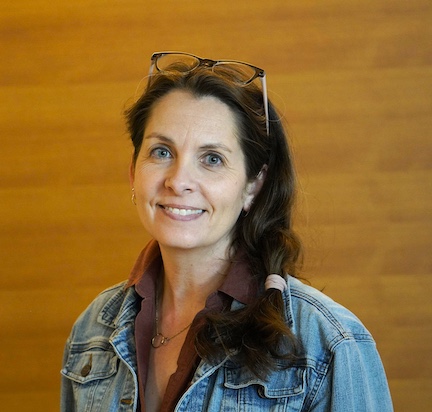
Sara Beth West is a librarian and a freelance writer focusing on book reviews and author interviews. In addition to Chapter 16, publications include Kirkus, Shelf Awareness, BookPage, Southern Review of Books, and more. She lives in Chattanooga.