Uncle Billy and the Art of Drinking
World War II and free-flowing alcohol on the European front gifted Billy with addiction
Mama once asked me, only once, if I loved Uncle Billy. He was her older brother. I said, “Yes.”
What I wanted to say was no, not always and not often. There were times when I hated him.
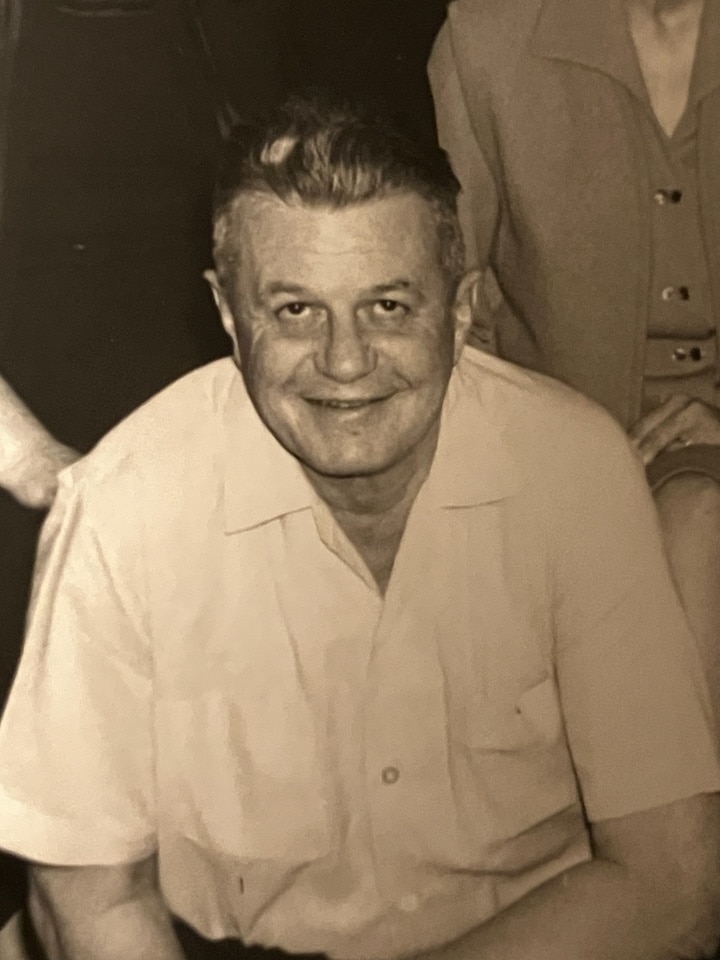
For my first 28 years — and for the eight years my mother and father were married before I was born — Billy and his addiction to alcohol ruled my family’s home life.
Uncle Billy was a man who could enter a liquor store, buy a pint of rum, stroll out with it, drink the whole pint in an alley next to the store, and sink down on his butt immediately in a blackout extraordinaire. If he didn’t have access to a liquor store or was too drunk to get to one — he didn’t have a car, thank God — he kept a supply of Aqua Velva in his medicine cabinet and would drink that. Even at 10 years old, I knew what the smell of Aqua Velva meant when I was near him.
Totally out of character — he was basically a peaceful man — my father threatened to beat Billy up if he didn’t quit drinking. Billy did not stop and Daddy did not beat him up.
My mother begged Billy to give up alcohol and persuaded his doctor to prescribe Antabuse for him, a drug she herself administered to him daily for at least two decades, giving him the pill and water, watching him swallow. On occasion, though, he managed to hide the pill under his tongue, spit it out, and go on a binge, never quite gauging correctly when that last pill was out of his system. Mama would find him vomiting violently the next day, having finished off a pint of rum when he thought it was safe. It wasn’t, of course. “I could have come over here and found you dead!” Mama was loud and crying while she mopped up the vile stuff before him on the floor. “You KNOW Antabuse can kill you if you mix it with alcohol!”
“I thought I had waited long enough.” Billy wiped his mouth, looking like he wasn’t sure he was through vomiting.
***
World War II and free-flowing alcohol on the European front gifted Billy with addiction. He returned from the war with some wonderful stories — it was the best time he ever had in his life — and a world-class capacity for consuming bottle after bottle of rum, whiskey, and wine.
Many of his war stories were about drinking here or drinking there, who passed out first among his buddies and himself. My favorite, though, was one that brought out a gentle, rather lovely side of him that I never witnessed otherwise.
He was stationed in central France and had come upon a small bistro in the countryside. He saw from the outside that there were red curtains on the windows. A sign over the front door declared the establishment to be “Le Café Rose.” The place held only four tables for two. In a corner was a tiny table for one, occupied by a woman with a glass of wine and two fried eggs. Billy, in his Army uniform, seated himself at the one remaining open table, ordered a glass of wine and watched the woman slowly take bites of egg and sips of wine. Her hair was blond, wavy, not curly, almost to her shoulders. Billy painted the scene carefully. Her lips were “the exact red of the curtains.” He heard music from a radio, something “very Edith Piaf-y,” and a faint aroma of lavender embraced him.
In about five minutes, he stood and walked over to the woman, put his left hand out to her, palm upward, and said, “Danse?”
She smiled and laughed silently. “Ici?” She looked around at the other patrons, conversing softly and eating their meals.
“Oui.”
She stood and moved close to him, placing her left hand on Billy’s shoulder and placing her right hand in his. He breathed in the aroma of her lavender scent “so sweet there were tears in my eyes,” he said.
They danced, barely moving, next to her table.
At that moment, as he told the story, there were tears of tender recollection in Billy’s eyes. And there were tears in mine.
***
Billy developed diabetes along the way and, at age 60, he landed in a veterans hospital with gangrene. I remember hovering at his bedside, watching with horror as the toes on his left foot, then his whole foot, then his leg, turned black. “We’re going to have to remove it above the knee,” the doctor said, scribbling something on a notepad, avoiding Billy’s stricken expression.
Billy was a man who had played tennis in high school, taking his team to a state championship. A man who, also in high school, won a diving trophy at Maxie Gregg Public Swimming Pool. And he liked to dance.
***
During the last six years of Billy’s life, he used a crutch to get around. Mostly, he sat in a worn recliner in his living room, watching television, listening to vinyl records of band music from the 1940s, and eating TV dinners. Nobody came to visit except my mother (administering her doses of Antabuse) and me (hoping for more stories of the “danse” type but never hearing them). There was also his girlfriend Celestine, who had met him in rehab during his third stint and wished he might suggest she stay over some evening. And then there was Ralph, the choir director at our church, an evangelical conservative Baptist by faith, serving a liberal Methodist congregation, maybe drawn to Billy as a misfit like himself.
Someone, I am not sure who among us, maybe Celestine, brought him detective novels and comic books regularly. Someone — I know it wasn’t me and I’m pretty sure it wasn’t Ralph or Mama — also brought him a pornographic magazine now and then.
Mama and I took turns heating his dinner every night.
***
At Billy’s graveside service, there were four of us: my mother, my father, me, and Ralph. Celestine would have been there, but she couldn’t get a pass that day from the mental hospital, by now her permanent place of residence. “I can’t tell you how much this bothers me,” she said on the pay phone she had to use.
Ralph asked to provide the eulogy and Mama in particular was more than happy for him to take on the assignment. As he spoke, Ralph quoted from memory several appropriate scriptural passages, a skill many Baptists have, in my experience. “Billy was a good man,” he said. “He had his demons, but he had a good soul. He once asked me if I believed he was going to heaven when he died. I told him I didn’t know, but that listening to him brought me joy and solace. And that’s what good people do for each other. So as far as I’m concerned, he is in heaven.”
Ralph returned to his folding chair, his back as straight as whenever he sat down at the organ. My mother was holding my hand and she squeezed it lightly. “Amen, “she said in a voice no one could hear except me. “Amen.”
For Billy, for the last time, we wept.
Copyright © 2026 by Peggy Culp. All rights reserved.

Peggy Culp retired from Vanderbilt University after working as a fundraiser for over 25 years. She has published fiction and nonfiction works in Shift (a publication of the MTSU writing program) and France Today online. Peggy holds an M.Ed. degree from Vanderbilt and a B.A. degree in English from the University of South Carolina. In her retirement, she writes, sings, and plays the ukulele.