‘Sublime Americana’
Jesse Graves and Larry D. Thacker’s collaborative poetry collection reflects on the long journey of grief
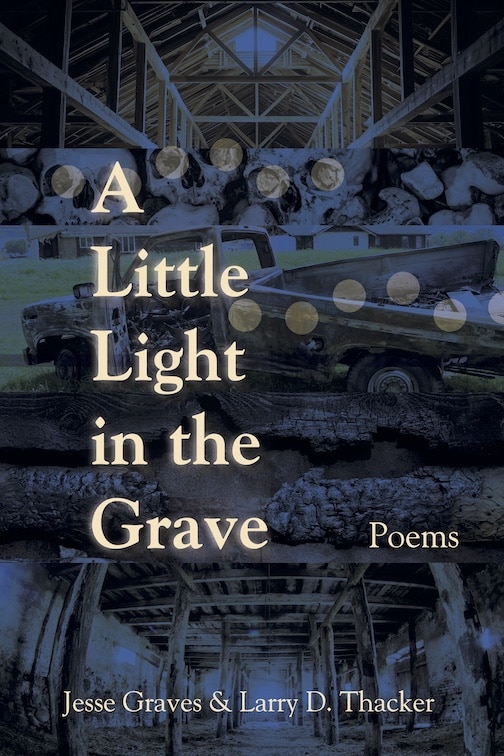
In A Little Light in the Grave, Jesse Graves and Larry D. Thacker honor their dead in surprising meditations on grief and memory. This poetry collection memorializes several lost family members but focuses on the poets’ industrious fathers, men who labored and loved with quiet intensity. As solid as tombstones, these poems stand as tributes, rituals of remembrance as potent as attending funerals, lighting candles, and leaving flowers. The poem “More Light” ends with a stark reminder that “We are born to become a relic of time.” Nonetheless, this collection traffics in beauty, as well, fleeting though it may be.
 The authorship of individual poems is never mentioned except on the acknowledgments page, and even there, it’s only partially explained. Any poem could have been written by Graves or Thacker, providing a sense of shared elegies, of shared grief. In this ego-less endeavor, there’s a sense that readers are included in this important work, as well. Despite the distinctly Appalachian backdrops, these poems feel universal, an acknowledgment that loss unites us all. “Age of sadness, age of burdened spirit,” they write in “Natural Burden.” And isn’t that every age?
In “My Father’s Barn,” a dilapidated farm building disappears piece by piece: “The barn is trying to grow back / into the hillside, reborn as trees again. / Its future, like mine, is to become the past.” These lines express a melancholy recognition that nothing manmade is permanent. Later in the poem, the speaker compares barns in general to ancient stone circles, “a beacon for some chthonic message no one left / alive knows how to interpret.” That is, histories are forgotten. Not even poems can keep them alive.
 Despite the heartbreak in this collection, there’s plenty of joy, too, in trying to capture the indomitable spirits of two men. The poets’ fathers labored their whole lives to provide stability for their families. Between the two of them, we have a Vietnam veteran, a steel fabricator, a long-haul truck driver, and a cattle farmer. Their hands are calloused, backs aching. They have, as conveyed in “Work Shirts,” closets full of practical clothes, now waiting forever to be put back to work. It’s clear that the poets admired their fathers.
By undertaking this collaborative project, Graves and Thacker join a long line of illustrious writers. Surrealist poets famously used parlor games as inspiration for their shared art. The exquisite corpse, for example, consists of a paper passed around a room, each participant adding a single line to the creation (while only being privy to the line above). Poets Denise Duhamel and Maureen Seaton have published several collections together and edited an anthology with David Trinidad called Saints of Hysteria: A Half-Century of Collaborative American Poetry. John Ashbery and James Schuyler’s A Nest of Ninnies is a novel that the poets dreamed up during a long car ride. Ashbery wrote for Dalkey Archive Press “…we began it simply to entertain ourselves. Once the prospect of publication arose, we continued to do so, hoping others might be amused too.”
Graves and Thacker approach their own collaboration with more gravitas, appreciating the delicate nature of grief. In “My Father’s Birthday,” the speaker reflects on the act of missing, simultaneously missing his father and wondering how his father managed while away from his family as a long-haul truck driver:
He crossed mountains and desert spaces,
saw sublime Americana, terrible and fine,
but rarely spent his birthdays at home.
I’ll always wonder: how much did he mind,
now that he has truly missed so many?
The use of “sublime” here — to indicate how awe contains the awful and awesome at once — speaks to the landscape flitting by the father’s truck window, but also to the recognition that a birthday can bring pleasure or pain. When a loved one passes, such milestones are often reminders that they are gone.

Both Graves and Thatcher have strong ties to Appalachia, and the distinctive landscape of East Tennessee provides a unified background to this book. Graves is the author of six poetry collections, including another co-authored title, Specter Mountain, with William Wright. Thacker grew up in Johnson City and has published five poetry collections. Between them, they have also published fiction, edited anthologies, starred in reality television shows, taught at universities, and won numerous awards.
The title A Little Light in the Grave appears in two poems. The first, “I wouldn’t mind a little light” begins, “I always wondered if there might be a little light / in the grave.” The speaker imagines being buried, somebody on solid ground above searching the gravestones for his name. The second, “A Few Words of Remembrance,” also features gravestones. In this poem, the speaker tries to remember all of his deceased relatives, associating them with pleasant memories like pies, dresses, and favorite stories. He speaks about light more metaphorically: “I would like to shine a little light in their graves.” That is, he would like to honor each person he’s loved who has left this earthly realm. He would like to honor them through remembrance. It’s a noble endeavor embodied by the poems in this moving, generous collection.

Erica Wright‘s latest books are The Museum of Unusual Occurrence and A Buyer’s Guide to the Afterlife. She lives with her family in Knoxville.