A Special Alchemy
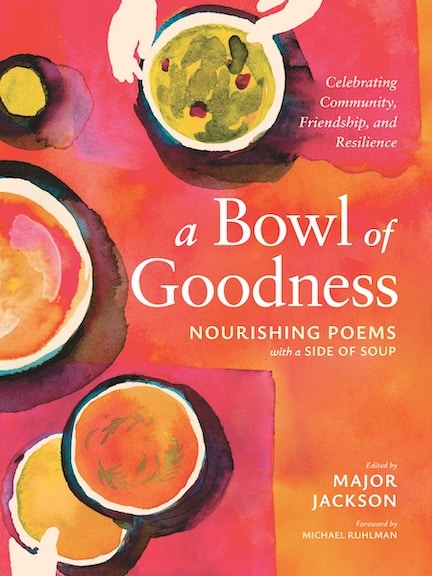
Major Jackson celebrates the heart-healing magic of both poetry and soup with A Bowl of Goodness
There is a special alchemy that starts with a heavy pot being placed on the stove. Oil, onions, and garlic lay the foundation, and from that humble opening, an entire world will be opened. The soup pot becomes a portal to a universe of flavor. Nashville poet Major Jackson understands this strange magic and celebrates it in A Bowl of Goodness, a collection of poems and occasional recipes. Jackson brings together the work of such bright lights as former poets laureate Rita Dove, Robert Hass, Natasha Trethewey, and Joy Harjo, alongside fellow Tennessee writers such as Ann Patchett, Lisa Coffman, and Kate Daniels.

Like an excellent soup, a good poem appears simple but is suffused with layered complexities. And both are better when shared with others. In the section entitled, “Sharing a Bowl,” Jackson argues that the poems he has collected “remind us that eating is an essential social activity, one that is more than a temporary fix for our hungers.” So, too, is poetry; even when read in isolation, a poem can connect the reader to universal truths across boundaries of time, distance, and culture.
In “Laksa at Lau Pa Sat, Singapore, 1999,” poet Divya Victor’s rhythmic lines sing off the page, fairly insisting that they be read aloud: “slurp bowls, open Os, wah so hot/ we laugh into our hungers / of gold, jade, steel, string.” I have never sat under an angsana tree, did not know the slang “lepak,” but I have laughed, open-mouthed, over hot bowls of soup, have felt the endless possibilities of youth. And now, if I wish to, I can make Laksa from the poet’s included recipe.
The section “Healing Agents” notes the medicinal properties of a good bowl of soup and the therapeutic power of both cooking and poetry in a season of pain or loss. Jackson recalls the time after his mother passed, when “I longed to experience her kitchen again, wanted to reexperience her harmony of ingredients, aromas, and flavors.” And Rita Dove knocks the reader to her knees with the opening line of her stunning “Soup”: “When the doctor said I’ve got good news and bad news, / I thought of soup.” A few lines later, when she describes what she wants — “not news / but the slow courage of the lentil / as it softened, its heart splitting into wings” — the poem takes flight, and the reader soars along with it.
Kevin Young’s “Ode to Gumbo,” makes the connection explicit: “Some/ say Gumbo / starts with filé / or with roux, begins // with flour & water / making sure / not to burn. I know Gumbo / starts with sorrow—// with hands that cannot wait / but must—with stirring / & a slow boil / & things that cannot // be taught, like grace.”
 This collection is full of breathtaking lines, poem after poem of beauty as well as pain. Jane Hirshfield’s “Da Capo” is practically a recipe itself with its evocation of carrots, herbs, and chestnuts. And then the final two lines: “You may do this, I tell you, it is permitted. / Begin again the story of your life.” Or in “Courage, 1983” by Ellen Bass, we get a love song to borscht — borscht!! — which closes with: “This too is courage: / to cook, to eat / to seize our daily lives.” At this point in the collection, I decided I might want nothing more than soup and poems for all my days.
Jackson knows the feeling. The section “Magic Kettle” points again to the similarities between the two art forms: “Both poems and soups are careful constructions of ingredients that culminate into a numinous experience for the gourmand, for the epicure of all things delicious, joyful, modest, and jubilant.” And in “soup poem #4392,” poet Shenai Chan makes this feeling plain: “I am coming home to my oldest, truest self when I make soup. I make a place that you can come home to, too, when I make soup. The day is long and cold and gray but inside there is a warm bowl of soup on our wooden table. And maybe that’s enough.”
So tonight, I will take down my large, heavy-bottomed pot. I will add oil, onions, garlic. I will come home to my oldest, truest self. And maybe that’s enough.
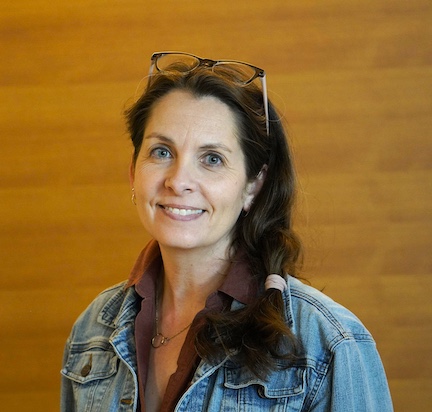
Sara Beth West is a librarian and a freelance writer focusing on book reviews and author interviews. In addition to Chapter 16, publications include Kirkus, Shelf Awareness, BookPage, Southern Review of Books, and more. She lives in Chattanooga.