‘A Beacon of What Is’
Three poets make memorable use of Tennessee settings
Lou Turner’s Twin Lead Lines
“How does a place become an utterance?” Nashville musician and poet Lou Turner asks in her debut collection, Twin Lead Lines. “How does a home give way to a yell, a cry, — an O?”

Circular patterns resonate everywhere in these energetic, formally adventurous poems. The opening poem announces this focus: “I write for an encounter of the O and the I.” The speaker describes a kind of dance between the O sound made by the speaker’s voice and the identity being formed through songwriting and the act of singing.
What elements does Turner swirl together in her own circle? Music, family, love, poetry, faith — each one in vibrant resonance with the rest.
Legendary Grand Ole Opry regular Little Jimmy Dickens takes a leading role in this collection. After learning that Dickens was her distant cousin, Turner delves deeply into this shared lineage through a kind of poetic duet, exploring Dickens’ origins, career, stage persona, and body of work with nuance and wit. “Little Jimmy sang the O in the country song / and the O in the hymn. // I crow the O in the folk song / crown the O in the sonnet.”
Turner depicts sonic expression on the page via spatial or formal experiments, such as unusual spacing, Venn diagrams, and book-length anagram couplets that appear at the top and bottom of each page. Alongside a few of the poems, Turner even includes QR codes that lead to accompanying soundscapes.
References to the well-loved hymn “Will the Circle Be Unbroken?” also recur throughout the collection, contributing to numerous iterations of circular patterns and forms. Add to this mixture references to twin-lead cable (which conducts radio signals) and the “twin lead” guitar playing style (which Dickens preferred), and Turner’s motifs of circuits and duetting take on even more dimension.
 As a musician, Turner has performed with group acts and on her own, releasing her most recent solo album, Microcosmos, in 2022. Many of her poems depict musicians’ lives in a rapidly changing Nashville, where the best advice for songwriting is to make “your ears an open mic for the music of the city.”
Old-school Nashville haunts and venues like J&J’s Market and Cafe, Brown’s Diner, The End, and Springwater appear. Anyone who’s thrown back a few during a long night at Springwater — or been soothed by the dark, scruffy intimacy of The End — will appreciate the fond specificity Turner brings to her poems about these beloved spots. But the deeper story she’s depicting is one of creative lives in motion, not confined in any particular version of the past.
Turner ends Twin Lead Lines with “Sestina for the Spinning Wheel,” which describes a road trip search for her West Virginia family roots. Sitting beside her beloved partner, the speaker questions her own motives, what fuels her restless drive for familial connections: “I believe in the ideal of chosen family,” she says, “but here I am, pumping all this blood. / Each its own heritage, each its own world.”
Through her startling and generous-hearted vision, Turner honors the lineages that claim us and the ones we claim for ourselves.
Twin Lead Lines
By Lou Turner
Third Man Books
64 pages
$18
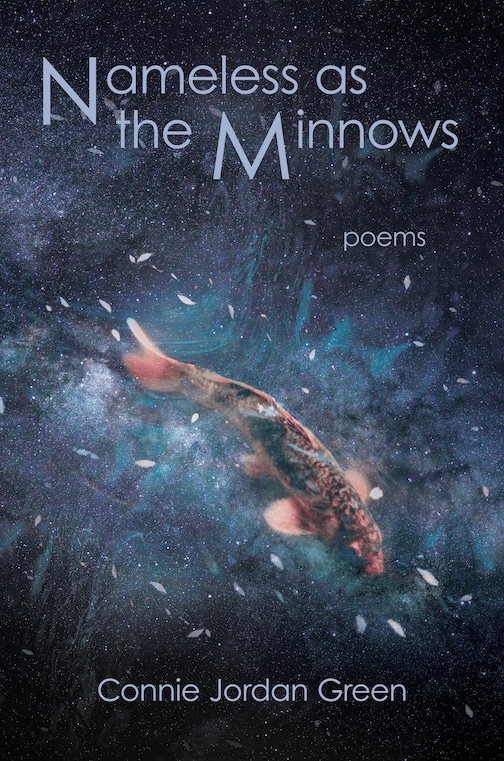
Connie Jordan Green’s Nameless as the Minnows
In the opening poem of Connie Jordan Green’s Nameless as the Minnows, the speaker invites us into her own past: a nine-year-old’s experience of floating in a lake, adrift among sensory observations and a palpable mystery. “I am yet nameless / as the silvery scaled minnows glinting through / the shallows, always just beyond my reach.”

Green skillfully renders the perspective of embodied memory, unstuck from chronological time or age: “my reflection in the water a brighter self I have yet to meet.” The luminous, insightful poems of this collection attune us to their sights and sounds, to their reflective rhythms and sense of motion.
Green has been inducted into the East Tennessee Writers Hall of Fame. The author of two previous collections and two novels for young readers, she now lives on a farm in Loudon County. But she grew up in Oak Ridge, where her father worked for the uranium enrichment plant. Green writes with sensitivity about the plant workers’ lives, about the families building a rich community life.
But that life also harbored a darker reality. All the while, clandestine work was taking place in the plant. The speaker recalls how little she understood then, “our world still a cocoon, our sleep / deep as the hills walling in our town.”
“What Never Happened” highlights the ways that imagination can heighten our early memories and daily fears. In our inner lives, Green shows us, such boundaries sometimes grow permeable.
 Many of Green’s poems retain a spirit of lightness, of wakefulness, even as their subjects verge into darker terrain. Green offers glimpses into the ways our toughest losses often present themselves, the unanswerable questions that won’t stop coming. And the cyclical nature by which we will move through life again, having incorporated these potent experiences — “a song that sang me through winter days / until light waxed us into spring.”
The final third of the book highlights seasonal rhythms of farm labor and gardening, entwined with nature’s pace and timing. Through her gift for dream-like imagery and elegant scene-setting, Green links observations of daily routine to the unfathomable vastness of the universe. These poems remind us that our origins are bound up in materials that once produced stars.
“Good,” written in conversation with Mary Oliver’s often-quoted “Wild Geese,” notes our ingrained human impulse to turn ourselves toward openness after hardship: “[This] evening stars will once more / pierce the darkness, light that is neither / good nor bad, is merely a beacon of what / is and has been through human memory.”
The final poem of Nameless brings us back the lake and to the woman in its waters. Again, the speaker swims among the lake’s fish. But by now, the speaker has matured, exuding self-assuredness as she swims “back and forth, shallow water to deep.”
One fish has singled her out, choosing to swim beside her in this daily ritual, “the fish a slender silvery / shadow of my buoyant body.” The rituals have changed. Her perspective and awareness have grown. But the enlivening spirit of mystery remains close, unexplained and joyful.
Nameless as the Minnows
By Connie Jordan Green
Madville Publishing
88 pages
$19.95
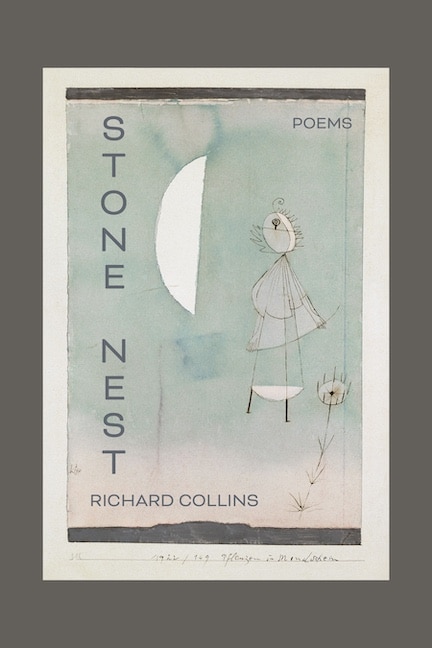
Richard Collins’ Stone Nest
On a mountaintop in Sewanee, Zen monk and poet Richard Collins set out to embrace a new era of his life with solitude, meditation, and inquiry. After decades of teaching in various countries, including the U.S., Wales, Romania, and Bulgaria — and a number of years as the abbot of the New Orleans Zen Temple — he now directs the Stone Nest Zen Dojo in Sewanee, where he currently lives.

The poems of Stone Nest chronicle more than Collins’ personal story. They also give a portrait of the dojo’s mountainous environment and depict the ways that human fates relate to the daily and seasonal rhythms of nature, the wonders of wildlife’s infinite variety, and the changeability of weather.
“Boulders the size of houses overhang the house, / shadows the size of my life cloud my horizon,” Collins writes. “The wind whistles through the ancient stones: / no need to be a monk to hear it.”
But the role that nature plays in Stone Nest is inextricably bound to the poet’s perspective. The book describes Collins’ focus as “attention to the art of nature and the nature of art,” and nowhere is that more apparent than in the descriptions of its mountain setting.
“Giacometti Forest” insists that the ineffable beauty of our own world is “better than any heaven / we might imagine.” At the same time, a stark winter forest scene beckons the speaker to notice every detail, such as “Fog that emerges from the warm / throat of the valley. / Fog that settles at the cold / foot of a neglected trail.” Here, in this stillness, lies “the beauty / of unacknowledged beauty.”
Elsewhere, the speaker furthers the book’s depiction of winter: “Nestled in the naked stone of winter, taking / stock and wisdomless, we anticipate the spring.”
 At such times, the presence of wit and levity can become crucial in the spiritual life as well as the poetic life. Collins refers to the practice of writing with the kind of wry fondness that can only come from those who approach their literary lives with the utmost devotion. “Old frogs can still skim like a stone / or a song’s echo / when they’ve had too much to drink. // Old poets, when they’ve had too much / to think, sink like a stone.”
Whether these poems are mourning the death of a longtime Master or reminiscing about the youth of a clever daughter who’s now grown, mortality is always present. “How like a storm are our short lives, flooded with forgetting / ashes and gold nuggets gushing down gutters in a stream.”
Still, this sense of the rapid speeding-up of life can also bring the shedding of assumptions and biases or outdated self-images that cause suffering. Collins entreats us: “Let it suffice // that you have outlasted the past. In time / the heart begins to accept the flaws in the design.”
Throughout Stone Nest, Richard Collins invites us to “dwell in the texture of the everyday.” Depicting life at a mountaintop Zen retreat, these poems also transcend the particulars of our mortal fates, even as they prize the beauty of the finite.
Stone Nest
By Richard Collins
Shanti Arts Publishing
126 pages
$18.95

Emily Choate’s fiction and essays have appeared in Mississippi Review, storySouth, Shenandoah, The Florida Review, Rappahannock Review, Atticus Review, Tupelo Quarterly, and elsewhere. She holds an M.F.A. from Sarah Lawrence College, served as one of the founding editors of Peauxdunque Review, and lives near Nashville, where she’s working on a novel.