Rampage on the Fringes
Katherine Grandjean tells the tale of America’s first mass murderers
In 1796, brothers Wiley and Micajah Harp moved to Tennessee, settling near a new, rough-hewn settlement called Knoxville. In their youth they had likely witnessed the violence of the American Revolution, which in their native North Carolina more resembled fratricide than a fight for independence. Within two years of their arrival in the sixteenth state, they began a murder spree that terrorized the frontiers of both Tennessee and Kentucky, resulting in the violent deaths of at least 20, and likely many more, people. Historian Katherine Grandjean has compellingly explored the Harp brothers’ story — and the possible reasons for their brutality — in Kingdom of Devils: A Tale of Murder in the Shadow of the American Revolution.

Grandjean, a professor of history at Wellesley College, became fascinated with the Harp brothers when she came across a brief mention of them in a 1960s-era history of violence in America. She found that several authors had explored the story, which, although widely known during the first half of the 19th century, was largely forgotten in the upheaval of the Civil War. Grandjean decided to investigate the Harps, noting in the introduction to Kingdom of Devils, “There is more to the story, and it’s the question that has gripped me: Why did they do this?”
“It takes some arrogance,” Grandjean writes, “to think you can decode the meaning of any murder, let alone a string of deaths that occurred centuries ago.” In her attempt to understand their horrific actions, she skillfully brings to life the time and place in which the Harps lived — the raw, sometimes lawless borderlands of a country unlike any that had ever existed. The United States in the 1790s was struggling to find its way. The new nation had rejected the notion that a king could dictate how and where a person lived. But a country that celebrated individual liberty and social mobility could be an unforgiving place for those who failed, either through their own actions or from circumstances beyond their control.
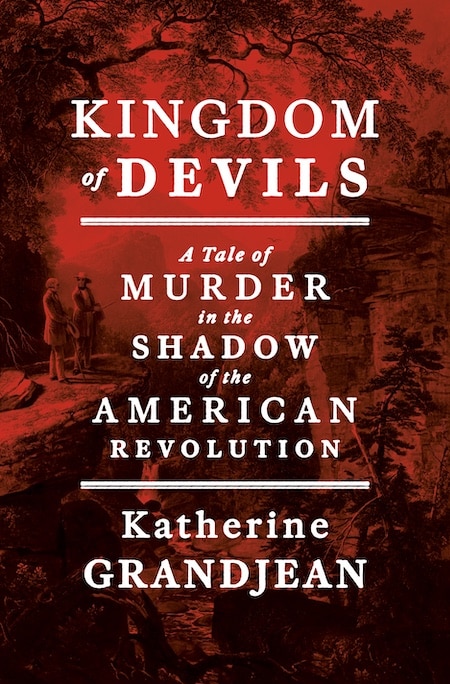 The Harp brothers failed in Tennessee. Wiley lost the property he purchased, a common occurrence in a state where deeds were often unclear or fraudulent, “a quicksand of rotten land claims.” Losing the land left him unable to pay off a loan, and when a lawsuit was filed against him, he, his brother, and their wives fled to Kentucky, killing innocent people wherever they traveled. The violence was so extreme, the numbers of dead so great, that for years after the carnage ended many people refused to believe it had happened. Surely, decent citizens thought, no one could commit such heinous crimes, especially in a nation with such high ideals.
Kingdom of Devils is as much a history of early America as it is a true-crime drama. Grandjean interweaves the Harps’ story with little-known or little-understood incidents that paint complex – and not always flattering – portraits of the ordinary and extraordinary personalities who sculpted the nation. Presidents Washington, Adams, and Jefferson were, of course, major players. But governors, bankers, Indian leaders, and sheriffs all contributed to the tumult in which the Harps’ terror thrived. The federal government had limited power in frontier areas where even state and territorial governments could not establish order. Unrest ruled. “The fringes of the United States,” Grandjean writes, “were a playground for criminals.”
And few criminals were as violent as the Harps. They have been described as America’s first serial killers, but Grandjean argues that label is inaccurate. Based on her research, she describes the Harps as “rampage killers,” men who failed to find their place in society and took revenge on anyone they perceived as having found success in life. They wanted, she believes, to make others feel their pain. In that sense, the Harp brothers were harbingers of horrors to come.

A Michigan native, Chris Scott is an unrepentant Yankee who arrived in Nashville more than 35 years ago and has gradually adapted to Southern ways. He is a geologist by profession and an historian by avocation.