All-American Surrealism
Jeff Apter surveys the life of rock’s premier ballad singer
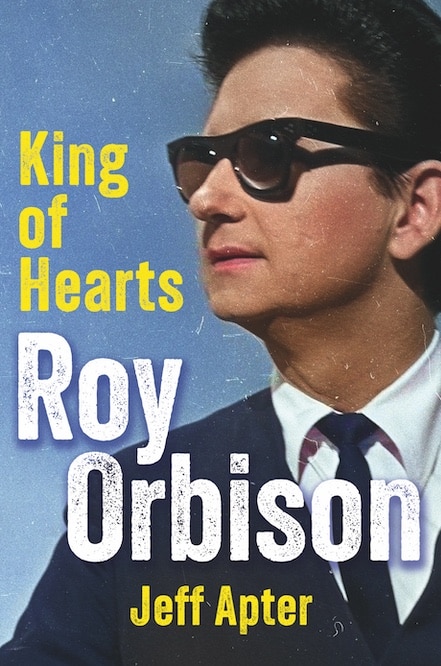
The period between 1958 and 1964 is usually marked as an interregnum in rock ‘n’ roll history. The careers of the original rockers — Elvis Presley, Chuck Berry, Little Richard, and Jerry Lee Lewis — had peaked by 1958, when Presley went into the army and Lewis was enduring his fans’ dismay about his recent marriage to his 13-year-old cousin Myra Gale Brown. Jeff Apter’s Roy Orbison: King of Hearts makes a case for an original rocker who took refuge in melodrama without resorting to the kind of outrage Lewis, Berry and Presley made their own. Orbison came to his position as rock’s premier ballad singer via rock ‘n’ roll, but his version of teenage dreams was shot through with sadness and all-American surrealism.

Apter’s narrative of Orbison’s life runs from the singer’s beginnings in Texas to his international fame in the late 1980s, when he joined the supergroup The Traveling Wilburys and lent his voice to director David Lynch’s 1986 film Blue Velvet, which made effective use of Orbison’s 1963 recording “In Dreams.” Lynch’s movie placed Orbison into a context that the singer struggled to understand — as Apter notes, Orbison was nonplussed by his initial screening of Blue Velvet. But like much of Orbison’s early ‘60s work, “In Dreams” was both uplifting and eldritch, and it lent itself to a movie about the violence that lies underneath everyday life.
When Orbison arrived at Sun Records in Memphis in 1956, he’d learned his craft by performing a mixture of Western swing, pop, and early rock ‘n’ roll in Texas venues like The Archway Club in Monahans. His first band, the Wink Westerners, were a typically eclectic group of the era, but the ascendance of rock ‘n’ roll would change all that. While he was at Sun, Orbison wrote the tune “Down the Line,” which Jerry Lee Lewis cut in one of the definitive rockabilly performances. Orbison certainly had the voice to rock, but Sun Records producer Sam Phillips didn’t seem to understand Orbison’s real talent as a singer of miniature operas for teenagers.
Orbison left Sun and signed briefly to RCA Victor, and by 1960 he’d moved to Nashville. His fortunes turned when he signed to a Nashville record label, Monument Records, which producer Fred Foster had started in 1958. Orbison, who was never conventionally photogenic, hadn’t fit into rock ‘n’ roll partly because of his lack of sex appeal, though that didn’t detract from his mesmerizing vocal style and his remarkable command of stillness onstage. Apter covers the Sun years well, but he doesn’t include Phillips’ famous quote about Orbison’s commercial potential: “I knew his voice was pure gold. I also knew if anyone got a look at him, he’d be dead inside a week.”
 In Nashville, with a crew of first-call session musicians that included bassist Bob Moore and drummer Buddy Harman, Orbison came into his own. The Nashville production style was plush and hedonistic, evoking suburban living rooms in affluent pre-Beatles America. Compared to his earlier work, Orbison seems altogether more commanding on 1959’s “Uptown” and 1961’s “Running Scared.” His singles provided catharsis in the New Frontier, and no matter if he didn’t move onstage — his voice was all you needed.
Foster knew a hitmaker when he heard one. Apter notes that some believe Foster signed Orbison by mistake when he mixed up Orbison’s Sun Records song “Ooby Dooby” with Warren Smith’s “Rock ‘n’ Roll Ruby.” Foster denied it, and his defense of his decision provides insight into Orbison’s talents:
Foster, not surprisingly, would come to deny this story, insisting that he signed Roy despite warnings he’d received from others in the industry that the man from Wink wasn’t going to make it, that he was “too ugly.” Roy may have looked nothing like Fabian or Frankie Avalon, but Foster knew better. “Man, I thought, is that superficial or what,” he said during the BBC documentary One of the Lonely Ones. He firmly believed that Roy was his guy.
Orbison’s career peaked with 1964’s “Oh, Pretty Woman,” which sported a guitar riff similar to the motif on The Beatles’ 1965 “Day Tripper.” Guitarist Wayne Moss transformed a lick he lifted from Little Richard’s “Lucille” into the figure that appears on the record, and Orbison’s foray back to rock also features guitar work by Jerry Kennedy, Billy Sanford and Orbison himself.
After The Beatles and the rock avant-garde came into prominence in the late ‘60s, Orbison — like Berry, Lewis and The Everly Brothers — found himself adrift in a new world of sound that seemed far away from the pursuit of rockabilly dreams. Orbison starred in a 1967 low-budget exploitation movie, The Fastest Guitar Alive, which appeared at the same time The Beatles released “I Am the Walrus.” Orbison died in 1988, just as he was being rediscovered by a new generation of fans. He was never hip, and it didn’t matter.

Edd Hurt is a writer and musician in Nashville. He’s written about music for Nashville Scene, American Songwriter, No Depression, The Village Voice, and other publications. He produced and played keyboards on The Contact Group’s 2021 album of 1970s covers, Varnished Suffrages.