Born from the Mountains
Emilee Hackney traces her journey from Appalachia to Harvard
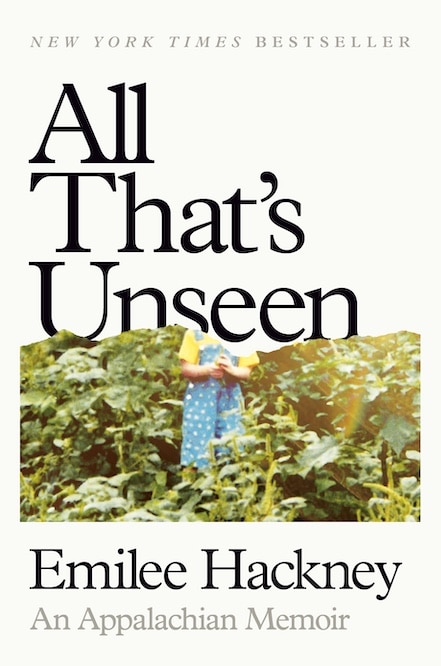
Emilee Hackney’s debut All That’s Unseen: An Appalachian Memoir traces her journey from Virginia’s coal country to Harvard, intertwining her own story with those of people and places often overlooked by the powerful. The coal barons who tear up the mountains are oblivious to their sacred grandeur. The fundamentalist church of Hackney’s youth turns a blind eye to women’s full humanity. Students and professors at Harvard see Hackney not as an individual, but as a stereotypical small-town hick. Looming over all these invisibilities is Hackney’s complicated relationship with the sometimes palpable, often elusive presence of God.

An eighth-generation resident of southwest Virginia, Hackney has her first religious experience at age 5. She describes “some kind of presence. Something sacred. Whatever it is, I begin to sense it in myself. It swallows me up in a slow wave of warmth.” Before that, the mountains around her home made her feel part of something greater than herself: “Even as a toddler, I’m awed by the mountains. … I feel as if I were born from them, as if my bones were formed from their dirt.”
The mountains continue to provide Hackney with a sense of belonging as she grows up, but God avoids her. She isn’t moved to “prophesy, speak in tongues, or ‘fall out’ in the Spirit” as do many members of her Pentecostal church. To combat her profound guilt about God’s lack of favor, she attends almost daily church services with her older boyfriend, Sam. She allows him to administer “domestic discipline,” i.e., spanking, when he feels she’s behaving disrespectfully. On one of the rare occasions when God speaks to her, she hears him telling her to marry Sam.
Later, she finds herself speaking in tongues at a youth group retreat. To continue earning God’s attention and Sam’s love, she decides against applying to college: “If I wanted to truly expand my horizons, I would have to seek God, not the world. … I wanted to grow in him, and him only. And that, ironically, made my world grow smaller.”
Hackney’s small world collapses when Sam is arrested for possession of child pornography. The betrayal she suffers is not just Sam’s, but God’s: “Now [God] was silent, and I was mad, and all the microscopic cracks in my faith, all the quiet doubts and fears, were growing.” She enrolls in community college, gets a job at Subway, and starts dating her “unsaved” coworker. Although still uncertain of her worth and purpose, she begins moving beyond the “thundercloud of punishment” she lived under for so long.
Hackney surprises her family – and herself – by applying to Harvard, a questionable choice in her community:
You are raised to revere the mountains and their people. Your people. The sense of community is so strong because the world beyond, you hear, is strange and cold and unforgiving, and you know this must be true because that’s where the politicians are, the coal barons, the rich and powerful who look down on Appalachia and care about it only as far as they can take advantage of it.
 In Hackney’s case, this bleak view turns out to be somewhat accurate. Her fellow students hear her accent and brand her a Trump-supporting rube. When she goes to a biology professor’s office hours, he browbeats her about the unsustainability of coal. Floundering in her classes and overwhelmed by “unbelonging,” she starts having sex with strangers, sometimes for money. As in her relationships with both Sam and God, she is still chasing “the sense of being wanted and seen.”
An expository writing class becomes Hackney’s first step toward lifesaving change. Writing a rebuttal to portrayals of Appalachia as “a supposedly hopeless otherworld,” she begins to find her voice. Humanities classes provide her with the language and opportunities to deepen her understanding of Appalachia’s complexities and her own identity: “There was so much to see when we looked past the obvious and defamiliarized what we knew, or what we thought we knew. When we broke through the glass domes of our own minds.” The defamiliarization is double-edged, however. When she returns home between semesters, friends and family suspect her of turning into a liberal and question her plans to move back home after graduation. “There’s nothing for you here,” her uncle tells her.
Hackney concludes All That’s Unseen by reconciling the opportunities afforded by her Ivy League education with the “tidal force of my mountain blood” that compels her to return regularly to Appalachia. This insightful memoir invites readers to join her in seeking out “the whole of a thing, its spectrum of contradictions and complexities,” even if we must break our own glass domes in the process.
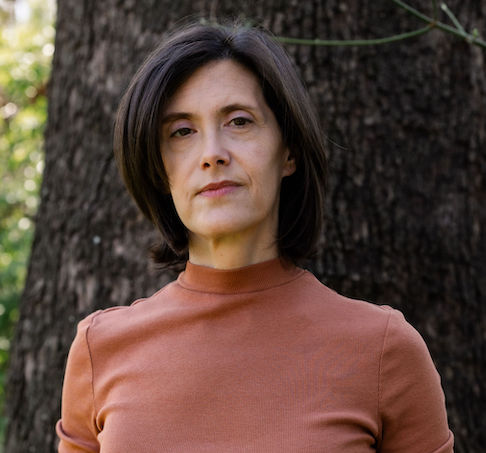
Whitney Bryant is a writer, teacher, and editor. Her work has appeared in The Georgia Review, One Story, Shenandoah, and Revisionist. A graduate of Vermont College of Fine Arts, she lives in Nashville.