City of Ghosts
Jay McInerney’s familiar characters look back while their children forge ahead
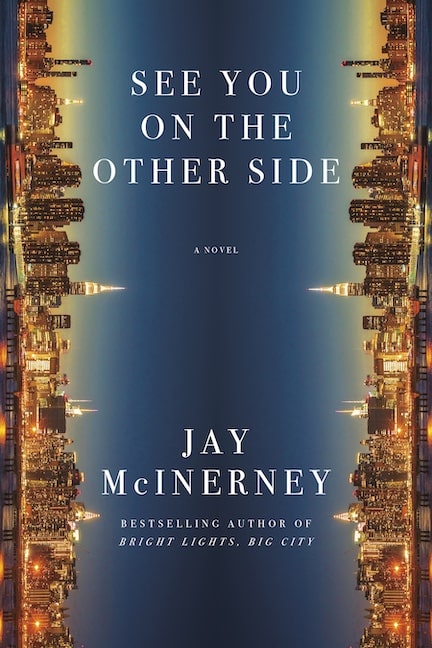
Jay McInerney’s latest novel begins on a nostalgic note, a 35th anniversary party held at the Odeon in Manhattan, site of countless binges in his characters’ riotous pasts. See You on the Other Side, the conclusion of a tetralogy about Corrine and Russell Calloway, opens in early 2020 with its central characters turning 60 and New York on the brink of a pandemic — an apt time to reflect on long-ago days when they felt they “would live forever and the night would never end.”

Lest the novel sag beneath the weight of retrospection, McInerney devotes much of it to the Calloway children, both in their 20s, who do enough Adderall and ketamine to compensate for their parents’ red wine and Cialis. While Russell contemplates having an affair with a young writer and Corrine frets about COVID, their children face crises of vocation and identity. Storey, who has worked in elite kitchens since dropping out of Brown, opens her own restaurant at an unpropitious time, when the virus begins to keep diners home. Her boyfriend Mingus, son of Russell’s best friend Washington Lee, follows in his father’s sybaritic footsteps, carrying on the downtown tradition of snorting coke in restroom stalls to fuel nights of club hopping.
Storey’s younger brother, Jeremy, a Bernie Sanders campaign staffer, becomes disillusioned about politics and confused about his sexuality. His current relationship, with a “bisexual whose life revolved around cosplay,” fails to satisfy him, in part because his partner can’t maintain her contrived anime persona. “In the light of day she looked all too much like a real girl,” Jeremy thinks.
The chief appeal of McInerney’s novel is its evocation of New York, which in Russell’s eyes retains its romantic, even seductive appeal. He relishes the city’s rhythms, its evening transition “between day and night, work and play,” a shift change from “labor to leisure.” After a decade of living in Harlem, the Calloways have returned to Greenwich Village, whereas their children have joined the migration to Brooklyn. To Jeremy, Manhattan is boring, “the land of offices and steak houses.” But to Russell, who grew up in suburban Detroit, the city represents vitality; it enabled him “to create himself, to forge an identity.”
The novel toggles between the old and the new, appropriate for a metropolis in perpetual states of reinvention. Washington knows that his youth is behind him. “Do you ever just suddenly feel old?” he says. “You wake up in the morning, you’re hungover for the ten thousandth time and your joints are stiff and your back hurts and it’s been years since you woke up with a hard-on.” For the older set, “the city is haunted, teeming with ghosts,” a limbo of closed restaurants, lost friends, and old lovers whose shades hover around the periphery of Corrine’s and Russell’s marriage.
 McInerney is too wise to root the story solely in the past. As one generation reckons former glories and plans its final hurrah, the younger crowd emerges with its own energies and ideals. As a book publisher, Russell knows that an era’s zeitgeist is defined by youth: “Russell believed that there was a music of the spheres audible only to young people; writers in their twenties had a chance to show us a new way of hearing and seeing the world.”
The coronavirus outbreak serves as a symbol for life’s capriciousness and brevity. Corrine sees the emergency as “vindication” for her long-held “sense of impending doom.” She thinks of COVID as the “sinister embodiment of a thousand vague fears of a lifetime,” an outlook shaped by her experience of the AIDS epidemic, which had been “selective, scything through a subset of the population, taking … some of the best and brightest and most colorful minds of her generation.”
The previous Calloway novels — Brightness Falls (1992), The Good Life (2006), and Bright, Precious Days (2016) — depict love, ambition, transgression, and redemption; here, McInerney confronts death. The title, pulled from a sign in a coffee shop window at the start of the shutdown, evokes images of the afterlife, matching Corrine’s mood, which darkens further when she tests positive for the disease. But Corrine wants to remain among the living: “She wasn’t ready to leave the world and the people she so loved.” Quarantined in her apartment, she feels “profoundly embedded in the physical world, even as she seemed to be floating away from it.”
With See You on the Other Side, McInerney is gambling that readers are ready for a pandemic novel. He took a similar risk with The Good Life, which portrays New York after 9/11. The new novel comprises a valediction to Corrine and Russell and offers a poignant reminder that, though the city ceaselessly regenerates itself, our time to savor it is fleetingly short.

Sean Kinch grew up in Austin and attended Stanford. He earned a Ph.D. from the University of Texas. He now teaches English at Montgomery Bell Academy in Nashville.