Glimpses of Vulnerability
Beth Ann Fennelly captures life in miniature
There’s a moment near the end of her The Irish Goodbye: Micro-Memoirs when author Beth Ann Fennelly describes the impact of artist Rob Townsend’s nude portraiture, in which “viewers are compelled to see themselves in the other.” With that phrasing, she’s also describing the empathy-building experience of reading memoir. We are made privy to details — fears, weaknesses, self-indulgences, petty prides — that we might not ordinarily encounter, shrinking the distance between self and other.

Fennelly, Mississippi’s Poet Laureate from 2016-2021, complicates that arrangement in assembling these “micro-memoirs,” a practice that fragments the revealing moments. This shorter mode, previously explored in her 2018 book Heating & Cooling, offers readers a bright spark of a scene in which there is, perhaps, less space to see themselves. This style of memoir befits a social media-saturated world, creating a written equivalent of carefully composed images, richly detailed but naturally limited by their frame. Brief though they may be, these aren’t all pretty pictures. Many pieces in The Irish Goodbye focus on grief — over her sister’s death years before, her mother’s memory loss and decline, the loss of friends and memories over the years.
Regardless of form, Fennelly’s signature spitfire is present, as seen in “Me vs. Slugs: Pandemic Edition,” which features Fennelly doing battle against the garden slugs threatening her pandemic garden. In “Tree Pose,” she describes the yogi’s gentle urgings: “Stop comparing yourself to others. If you compare, you are not a tree, you cannot be a tree.” Fennelly’s response? “Bitch, I’m a tree. I’m just a species of competitive tree.”
There are a handful of longer pieces in the collection, and these often turn the poet’s descriptive power toward someone else, as in “My Mother-in-Law in the Mirror,” a beautiful memorial to her husband’s mother, Betty, who kept a Post-it note on her mirror that read, “It’s not about YOU.” Here, Fennelly acknowledges that her admiration for the ever-humble Betty springs from their differences: “Any Post-it stuck on my vanity mirror would proclaim, ‘Why YES, darling! It IS about you!’” But pieces like this one, where Fennelly brings someone else’s life into the frame, proves her avowed self-centeredness at least partially wrong.
 One of the most memorable figures in the collection is the little girl Fennelly encounters at the refugee aid station where she volunteered in Germany: “Say her dark ringlets cascade down her narrow shoulders and her eyes are large and blue and clear from being scrubbed by wars, by all she has seen in her — what — six years?” Despite what she’s seen, this child is not helpless but as full of fire as Fennelly herself. She refuses to accept any old coat, holding out for the rabbit fur jacket, and then skinny jeans, and then a sparkly pink backpack and a stuffed animal, despite being told she could only choose one: “One, her finger thrusts again, and then she threads her arms through the straps of the glittery backpack, settles it over her balding rabbit jacket, and saunters away down the terminal.”
Fennelly’s language is as fierce as the girl herself, celebrating the youngster’s disregard of expectations for proper refugee behavior, imagining her first as “an ice princess on top of a sled” pulled by horses racing through the snow and then at the end envisioning her “alive because she nurtures such an exquisite contempt for death, and her contempt has catapulted her out into the moonlit snow where even now she is whipping the horses to make them run faster, whipping the horses unnecessarily, whipping the horses simply because she can.”
Though the micro-memoir format tends to keep the author partially concealed, the final essay of the collection exposes her quite literally. “Dear Viewer of My Naked Body” describes how she first encountered the work and philosophy of Rob Townsend. She has to convince herself to pose for what would become a series of 12 larger-than-life nude portraits of Oxford, Mississippi, residents. She raises some great questions, arguing, “If I hate that middle-aged women are looked through, should I not then offer one to be looked at?” When the painting is finished, she expects to feel critical of her flaws, but “my primary reaction,” she explains, “was awe.” Awe at the artist and his undeniable skill, sure. But also at the way the portrait reaches something universal: “I think first I recognized myself, and then I recognized my humanity.”
“Dear Viewer of My Naked Body” shows Fennelly at her finest, as well as her most vulnerable. She writes, “Maybe perceiving each other’s humanity makes us human. Recognizing ourselves in each other. Acknowledging our collaboration in the great human experience.” While many readers may not curse the slugs in their garden or pose nude for a celebrated artist, it is this vulnerability we all share and will always respond to.
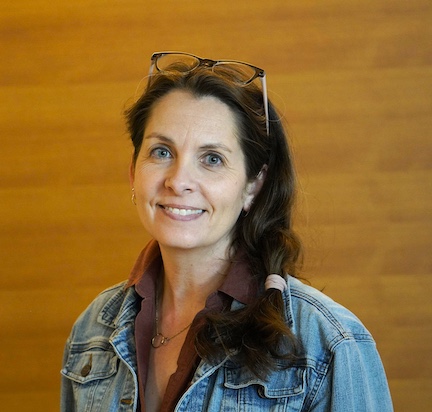
Sara Beth West is a librarian and a freelance writer focusing on book reviews and author interviews. In addition to Chapter 16, publications include Kirkus, Shelf Awareness, BookPage, Southern Review of Books, and more. She lives in Chattanooga.