‘The Healing Game of Art’
Book Excerpt: Everyday Apocalypse
The task of the artist — that’s everyone deep down — in an age of empire — that’s perhaps every age —is to feel it all and act like it. One thing I can tell you is we’ve got to be free. Because we dwell in mysteries beyond formulation and violence beyond our capacities to respond to it, we have work to do that begins with the feeling function.
 My mentor Will Campbell named the challenge: “I discovered long ago that the only way we learn from one another is by being willing to bare as much about ourselves as our nervous systems will let us, which is never very much. Consequentially, we don’t learn much from each other.”
Nervous systems we will always have with us. The job is to make the most of them together with others over and over again. This calls for conviviality, a space for mutual submission to the authority that is and was and will be the crazy little thing called art. Art calls for the constant overcoming of the sham of separateness, the myth of critical detachment in all its sneaky, usually imperial forms. Broad is the path to empire. Narrow is the path of art and artfulness.
One televised exchange once exposed the empire state of mind to me in a peculiarly helpful way. It was the poet Allen Ginsberg in conversation with the pundit William F. Buckley on PBS’s Firing Line. Ginsberg has held the floor for an unusually long time through the recitation of a poem all the while holding Buckley’s gaze. Buckley begrudgingly praises his eloquence as beautiful but with a to-his-mind crucial qualifier: “Well, you know what in my judgment is unsatisfactory about this analysis, I really don’t think — incidentally it is not so much analytical as it is poetical …”
Ginsberg interjects, “Oh, poesy is the oldest form. … Analysis is a later form.”
 Buckley, for once, had no retort. Think about it. We can analyze away, but the point (poetry’s the older form) is a palpable hit to the imperial claim of detached, magically disembodied judgment. Analytic posturing, let the reader understand, is the latecomer in the human barnyard, and the seat of judgment — justly occupied by some humans over others — is perhaps the most fantastical myth of all. The lyrical, meanwhile, precedes the analytical. Poetry, in fact, generates analysis as a form. Our perception of reality is relentlessly narratival, just as every fact is a function of relationship. Spirit, we have to understand, knows no division. Art is spirit overcoming that which divides us from ourselves and others. Think ancient unity of human being.
Ginsberg said poesy is the oldest form. I don’t think he’d mind when I say art, which includes poetry, is older. I’m talking sound and song and cave drawings. I’m talking cartoons. Pick a cartoon. Any cartoon.
I am here to champion The Simpsons. I speak as one kindasorta saved by television. Or, more specifically, televised creative content. In sometimes data-poor environments, content reaching us through screens can function as a kind of benevolent Trojan Horse that ambushes our minds with the lives of individuals and cultures to which we might not otherwise be capable of connecting ourselves. Storied content can create solidarity with the less familiar by encouraging us to wonder what it would feel like to be someone else in a situation drastically different from our own, thus cultivating the possibility of empathy. When it’s art, it does this.
When it’s empire, content caters to our own worst instincts, driving us to base our identity in who and what we hate and what we purchase, hijacking our hopes with the emptiest of slogans and scenarios, and wasting our sympathies on performers. Empire banks on fear, and screens misapprehended numb us to our own psychic deterioration.
The Simpsons, however, plays the healing game of art. It recommends a particular kind of seeing, a way of looking at people. These characters (one is tempted to call them creatures) have very little that would immediately command our admiration. Generally speaking, they are remarkably selfish most of the time. They are susceptible to whatever wind of hype or false promise of fulfillment holds their hearts captive in each episode. Their frequent failure to value one another properly makes their life together one disaster after another. In short, they are just like us, only more so. And yet something about them commands affection. All are soft and big-eyed and strange. They’re completely incapable of hiding their feelings and motivations. Whatever occurs to them comes out of their mouths almost instantly, however damning, irrelevant, or nonsensical it is. But for all their powerlessness, they are all the more precious. Their weakness does not provoke derision. In their loud impotence, bumping through their stories like a bewildered bunch of open wounds, we find them dear.
By facilitating this much-needed way of looking through an amused, affectionate puncturing of pretension and unmasking of selves, The Simpsons fulfills the purposes of apocalyptic. Perhaps it begins with a humor that isn’t contemptuous. Perceiving frailty and inconsistency in one another need not trump due reverence. In fact, when occasionally catastrophic ineptitude is viewed as our common plight, consistent condescension is hardly an option. As a substitute for death-dealing disdain, we get to feel ridiculous together, refusing the disgust that rises when we see our own brokenness reflected in another by somehow breathing in the clean, intoxicating air of a mutual confession of personal screwed-upped-ness now and then. To hold ourselves apart from one another as if there’s any such a thing as randos is a form of living death. It also renders us immune and impenetrable to the righteous witness of comedy. Jean Bethke Elshtain once offered precise language for the human assignment: “We are not perched on top of the earth as sovereigns; rather, we are invited into companionship with the earth as the torn and paradoxical creatures that we are.”
It’s a strange invitation, but The Simpsons serves as, at the very least, a healthy reminder of this clumsy companionship. We need reminding. Without it, a life can become a vast solitude in which I fancy myself somehow magically distanced from the deeply flawed masses, perpetually apprehensive that I might somehow get numbered among them. Like all great satire, The Simpsons invites us to find ourselves within life’s rich pageant. Celebrity guests, called upon to lend their voices to the show as themselves, are willingly subjected to lampoon as are we. Prepare to partake in a humiliating joy. No human is exempt.
The Simpsons holds up a mirror to the confusion of our times. Its quandaries are ours. We’re transported into a carnival realm, an outlandish exaggeration of our own world, not unlike a fairy tale but far too familiar and reminiscent of our everyday life to be dismissed as complete fantasy. Like any art, it makes more tangible and brings more plainly to our attention the warmth and tenderness and beauty underlying our existence. Empire cuts us off and renders us estranged from such feelings. Art, that tiny but growing revolution of intimacy, brings us back to ourselves.
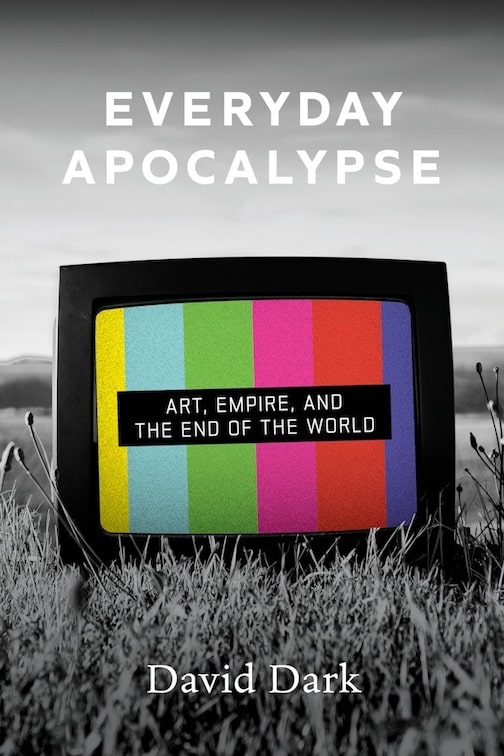
Excerpted from Everyday Apocalypse: Art, Empire, and the End of the World by David Dark (Vanderbilt University Press). Reprinted with permission. Copyright©️ 2025. All rights reserved.

David Dark‘s previous books include The Possibility of America, Life’s Too Short to Pretend You’re Not Religious, and We Become What We Normalize. Everyday Apocalypse, originally released in 2002, was published in a fully revised edition by Vanderbilt University Press in October 2025. David Dark lives in Nashville and teaches at Belmont University and the Tennessee Prison for Women.