The Prayer and Preservation of Bringing Communion to the Sick
Serving communion to my mother-in-law was an expression of love and gratitude
In Willa Cather’s 1918 novel, My Ántonia, the young bohemian Anton Jelinek tells a story about bringing communion to dying soldiers in a camp near his village in Prussia during the 1860s Austro-Prussian War. There had been a cholera outbreak in the camp.
“All day long our priest go about there to give the sacrament to dying men,” he says, “and I go with him to carry the vessels with the Holy Sacrament. Everybody that go near that camp catch the sickness but me and the priest. But we have no sickness, we have no fear, because we carry that blood and that body of Christ, and it preserves us.”
I have not carried the body of Christ to dying soldiers in a camp overrun with cholera. I’ve merely carried it in my car from my Catholic church in the Donelson area of Nashville, about a mile away to my home, to bring it to my mother-in-law, Madge. On the journey, I passed a half dozen other churches of various denominations, a CVS and a Walgreens, a Publix and a Kroger, a liquor store, a vape shop, and a vegan bakery and coffeehouse. Donelson really has everything you need. The biggest threat I faced was the temptation of the Waffle House around the corner from the church, where my family likes to have a late breakfast after mass. Administering Holy Communion is to be taken seriously. The bread of life should take priority over any other sustenance, including eggs-over-medium with wheat toast and grits. Or bacon extra crispy, the way Madge liked it.
The biggest psychological threat on the drive was the fire trucks barreling out of the Engine 28 firehouse, sirens blaring and turning right in the direction of my house. If you dial 911 in Donelson, the 28 gets dispatched.
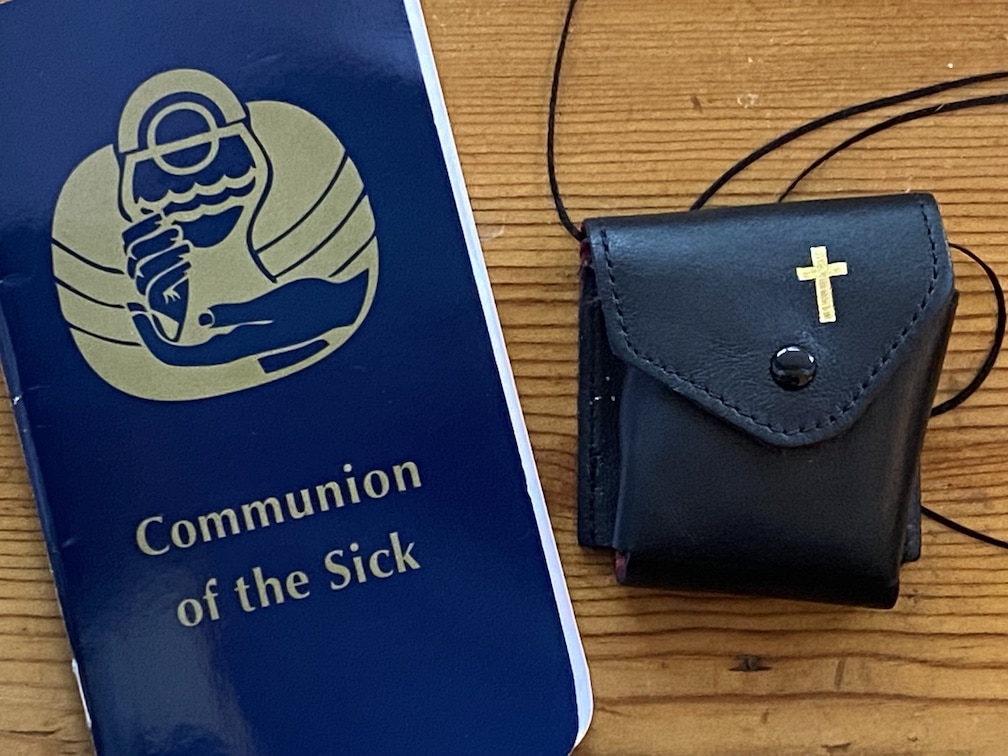
There are guidelines and procedures to bringing the sacrament to the sick and homebound. One needs a special vessel, typically made of brass and known as a pyx, to carry the most precious Body of Christ. While not required, you can also use a small pouch, a burse, to carry the pyx. Mine, made of black leather and given to me by my pastor, hung around my neck. It’s common to get communion for someone else at the same time you receive it during mass, by holding up the pyx and signaling with your hand to the priest or deacon how many hosts you need. Once you arrive home to administer it, you must follow as best you can the prayers, readings, and responses of the Roman Rite of Communion of the Sick in Ordinary Circumstances.
My mother-in-law’s increasingly debilitating cancer had made it difficult for her to join us for mass, so every Sunday, for about six months, with the burse hanging around my neck and the Body of Christ close to my heart, I would bring the sacrament to her. She would mute the television, and together we would say the prayers and responses of the Rite before I served her communion. I remember us always looking directly into each other’s eyes at that moment, bonded not only as mother and son-in-law, but in our faith.
Sometimes my wife, Keri, and daughters would join us. The whole experience might take 5 or 10 minutes. It would end with Madge saying, “Thank you, Joe,” and me saying, “Thank YOU.”
Keri was her mother’s main caregiver during this time. For a year or more, she managed the many doctors’ appointments and treatment schedules and prescription plans, until the doctors’ appointments became hospice visits, treatment was no longer an option, and picking up prescriptions meant measuring out milliliters and administering dosages. Love became compassion; care became exhaustion.
Over my mother-in-law’s final months, I became her chaplain of sorts. In addition to bringing her communion, we planned together which priest she preferred to celebrate the sacrament of Anointing of the Sick, whom she wanted to offer Last Rites, and whom she wanted to celebrate her funeral mass. When she decided she wanted the priest who knew her the least to celebrate the funeral and say the homily, she asked me to arrange a dinner so they could talk. While I found it a curious decision, her reasoning had to do with a single homily she had heard him preach in which he emphasized that the proper response to Jesus saying, “I love you” was “I love you, too.” I couldn’t argue with that.
During what would be our final Lenten season together, she found me reading St. Thérèse of Lisieux’s autobiography, The Story of a Soul, and asked if she might borrow it when I was done. Not knowing how long it might take me to finish — I’m a slow reader — or how much time she had left, I bought her a copy. I discovered her on our sun porch one evening reading it, though she hadn’t gotten far. “It’s a little slow-going at the beginning,” I said. “There isn’t much happening and sometimes it’s confusing. Her sister is her mother superior, so when she’s addressing her dear mother, she’s talking to her sister.”
“Oh. Well, that explains it,” she said.

I’m not sure she got much further. But no matter. I knew St. Thérèse’s “Little Way” of doing ordinary things with extraordinary love spoke to her. Had she made it toward the end, she would have come across this, which as someone who prayed the Rosary every night, she would have understood well: “Whenever my soul is so dry that I am incapable of a single good thought, I always say an Our Father or a Hail Mary very slowly, and these prayers alone cheer me up and nourish my soul with divine food.”
Prone, like the rest of us, to the occasional critical thought, she might have also gotten a kick out of it. Madge, like St. Thérèse, was nothing if not honest.
And then this: “Prayer, for me, is simply a raising of the heart, a simple glance toward Heaven, an expression of love and gratitude in the midst of trial, as well as in times of joy; in a word, it is something noble and supernatural expanding my soul and uniting it with God.”
Bringing communion to Madge was all of that. A simple prayer for me and her and my wife and daughters. A raising of the heart. An expression of love and gratitude in the midst of trial. Noble. Supernatural. Uniting. And like Anton Jelenik says in Willa Cather’s novel, it preserved us.
Madge received Holy Communion for the final time as part of Last Rites — known in that instance as viaticum, or provisions for the journey — in early May of 2025. She passed away three days later with all of us, her children and grandchildren and son-in-law and daughters-in-law, surrounding her, holding her hands, thanking her, and telling her we loved her.
We knew she could hear us and was saying, “I love you, too.”
A few weeks after Madge’s funeral, we returned as a family to Waffle House after Sunday mass.
The bacon was extra crispy.
Copyright©️ 2025 by Joe Pagetta. All rights reserved.

Joe Pagetta’s writing has appeared in America: The Jesuit Review, Ambassador (National Italian American Foundation), Today’s American Catholic, Tennessee Home & Farm, Tennessee Historical Quarterly, and Wordpeace. His book on Fr. Aloysius Orengo and Catholic life in 19th–century Tennessee is scheduled to be published by Vanderbilt University in the summer of 2026. He currently serves as the director of communications at the Tennessee State Museum and lives in Nashville with his wife and children. More at JoePagetta.com.