A Cure as Vast as the Violence
The writers collected in The People’s Project grapple with an era of tumultuous change
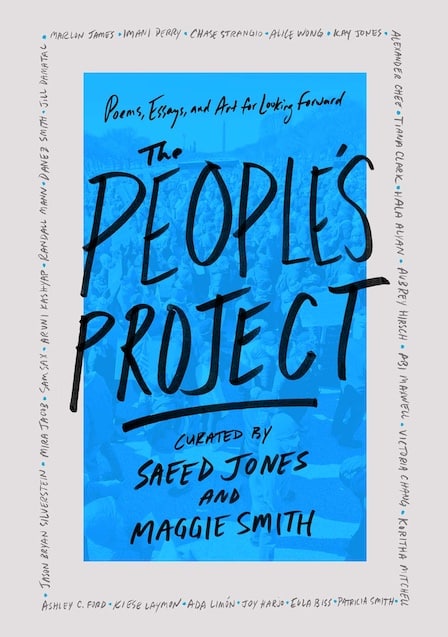
In the wake of the 2024 presidential election, celebrated writers Saeed Jones and Maggie Smith attempted what so many of us have struggled to do: process national events that have unleashed an onslaught of dangers and find language to convey our rapidly changing sense of reality. As a response to this fraught moment, Jones and Smith assembled The People’s Project, an anthology of work from 27 contributors which they describe as “a community in book form.”

When Smith drafted a note called “My Own Project 2025,” its central intention became “No self-abandonment.” “We will not disappear ourselves, the way we will not allow others to be disappeared,” Smith writes. “We are writing the story every day.”
But what form this new story will take remains unknown for now. Former U.S. Poet Laureate and University of Tennessee, Knoxville professor emerita Joy Harjo evokes a kind of historical listening post in her poem “Catching the Light.” “Listen now as Earth sheds her skin,” she enjoins us. “Listen as the generations move one against the other to make power. We are bringing in a new story.”
Jones, a Memphis native, offers his own “Project 2025,” which unfurls as an exaltation: “I am / pulling the voices of people I desire / and love and trust and worry over / into me. I am inviting them into the bright / dark of my soul.”
Victoria Chang’s “Ode to Joy” leans into the generative consolations of art-making: “How can I move radiance forward?” In “Good Pain,” Tiana Clark, who grew up in Nashville, addresses this era via her poetry-writing practice. “I crave resonance now. The uncertainty / is the only certainty we have, which means / I have to keep trusting that who I am right now / is enough,” she writes. “Whatever I am working on right now / is enough.”
In “Fix Up, Look Sharp,” Man Booker Prize winner Marlon James describes his post-election impulse to dial up his personal style, participating in a long lineage of expressing “Black self-possession” through glamor. James writes, “These days I’m not just putting on clothes, I’m putting on armor. I want something that smells an awful lot like victory.”
But in this period of escalating threat and division, processing the severity of our fear sometimes takes precedence. Danez Smith’s unflinching poem “Time of War” insists: “The first thing you need to understand is fear.” This fear is personified as a monster wreaking many kinds of destruction. The speaker sifts through their longing for freedom while dreading the toll this battle will take.

The People’s Project reflects just a sampling of the multiple ways we may relate to our current circumstances. The title of Kiese Laymon’s essay — “And. But. Ugh. Yet. Y’all. Mmm. Yes.” — highlights the complexity of attempting to process what this era of political and cultural tumult may require of us.
In “Let’s All Stay Alive,” Alexander Chee recounts his grandparents’ harrowing story of survival during the leadup to the Korean War. Jill Damatac’s “Non-Citizen,” which invokes Claudia Rankine’s masterwork Citizen, tracks the daily terror of navigating modern American life while undocumented. Lauded poet Patricia Smith expresses a Black mother’s anxious attempts to prepare her daughter for a racist world in “Chile, I’m not playing with you! Look at it!”
Times of great danger can also lead to bracing experiences of awe and beauty. Poet Ada Limón illuminates one such encounter in “Watching the Valley Oaks While Waiting to Become Braver.” Surrounded by forest trees, the poem’s speaker freezes in fear when a fierce raptor circles overhead. In this moment laid bare, Limón evokes internal dislocation, when a host of unmooring truths and possibilities are exposed: “But if I fix my senses to you, / in rapt and secular prayer, / and give myself one more hour / to stare and stare and stare, / I might recall my nature too, / and let my little trumpet blare.”
Defiance against oppression comes in many forms. The People’s Project reflects the rich diversity of perspectives on what resistance looks like. In her essay, Eula Bliss explores the relationship between resistance and collaboration under Nazi occupation in Vichy France and how blurred those ethical lines became for many French citizens during the wartime years. Bliss points out: “Resistance was not a fixed position, but a decision that had to be made over and over again.”
The writers collected here entreat us to seize this moment as a crucial opportunity to advocate not only for our personal fates, but also for the well-being of everyone. Jason Bryan Silverstein writes in his essay on systemic healthcare failures: “The cure must be as vast as the violence.”
Disability rights activist Alice Wong gives an elegant appreciation for the wisdom that disability can instill when it comes to resisting dominant culture’s productivity-based values. “[The disabled] know how to live with uncertainty, unruly bodyminds, and constraints beyond our control,” Wong writes. “Disabled people have such survival skills that come from living in a world that actively seeks to erase us.”
 Aubrey Hirsch’s short comic, “Raising the Resistance,” praises the everyday work of bringing up children as another expression of resistance. In “For Hope,” Abi Maxwell describes the unexpected support received from an elderly neighbor when her family relocated to create a safe, supportive life for Maxwell’s transgender child. Kay Jones’ “Portrait of Myself as a Boat” reckons with pregnancy during this embattled time.
Many of these works pose crucial questions about which battles we must wage on behalf of future generations. A lyrical essay by Imani Perry orients herself within a bloodline of fighters for greater freedom among myriad facets of systemic racism. “That inheritance is now a duty to pass down,” Perry asserts.
The People’s Project’s closing poem, Randall Mann’s “Puzzle,” creates a mirror image of itself, repeating lines while utilizing shifts in line breaks and punctuation to alter the reader’s understanding. This structure mimics the rumination, numbing, and confusion created by processing difficult change.
Mann opens with these lines: “Something ends. Something else begins / in a knowable shadow / like a partner.” He closes with these same phrases reversed, slightly altered to reflect a shift in the speaker’s perspective. Having processed the seriousness of the danger, he then turns toward stillness and discernment.
In this turbulent era, we, too, must willingly engage with our “knowable shadows.” These aspects of ourselves may be uncomfortable “partners,” but they hold the necessary truths that may guide us safely forward to enter a better future. The People’s Project is an arresting artifact of a troubled threshold.

Emily Choate’s fiction and essays have appeared in Mississippi Review, storySouth, Shenandoah, The Florida Review, Rappahannock Review, Atticus Review, Tupelo Quarterly, and elsewhere. She holds an M.F.A. from Sarah Lawrence College, served as one of the founding editors of Peauxdunque Review, and lives near Nashville, where she’s working on a novel.