A Grave or a Garden
In Henry Wise’s latest novel, an unknowable swampland hides dangerous secrets
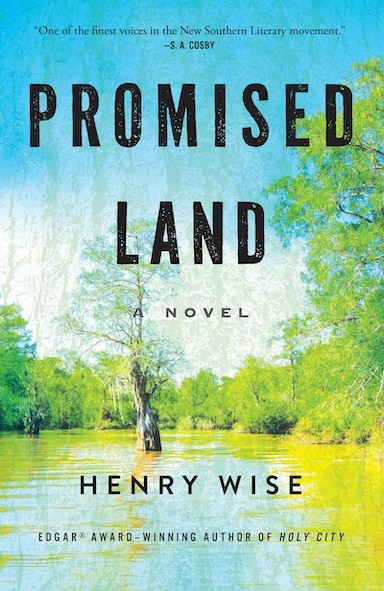
With the Snakefoot swamp in Southside Virginia, Henry Wise has created one of the most memorable settings in recent crime fiction. It’s the kind of place that attracts poachers, killers, mystics, and anybody else who doesn’t fit into polite society. The swamp was “so generative that it seemed anything could grow, even death.” The tangled tree roots and oily waters make a good metaphor for Wise’s latest novel, Promised Land. At times, the story seems impenetrable, but if you look hard enough, shadows turn into people, mysteries into motives.
Promised Land opens with an injured man fleeing his pickup truck and heading for the serpentine terrain of the Snakefoot. It’s not the sort of place that most people can survive, but Rainbo Boon is not most people. He’s a locally renowned hunter and trapper. Even shot, he’s formidable. As Deputy Will Seems and his partner Tania Jameson begin their investigation, they realize that they might have to uncover more than clues to find whoever tried to kill Rainbo. They might have to uncover some local history that wants to stay buried.
To complicate matters, Will Seems has seen better days, as have most of his neighbors. Promised Land picks up where the events of Wise’s first novel Holy City left off. Seems nearly got himself beaten to death by confronting the dealers who hooked his best friend on drugs. And now that best friend has vanished, leaving Will broken mentally as well as physically. Somehow Sheriff Mills still thinks his deputy is up for the job — or hopes he is, at least — because Mills has his hands full with arson. Somebody has burned down the local sawmill and started sabotaging a housing development.
As with Holy City, there are no clear heroes or villains in this story. Everybody is complicated and compromised, none more so than Rainbo’s grandson Buck Tomlin. Buck doesn’t trust law enforcement and conducts his own investigation, but the secrets he’s hiding make him dangerous and vulnerable in equal parts. Like so many of the characters who grew up in Euphoria County, he’s got a twisted but firm moral code. His former girlfriend Arlene writes in the paper, “Stories, like bodies, should remain buried in the delicate ecosystem that we have.” How is anybody, even a pair of capable detectives, supposed to battle that sort of ethos?
 As it progresses, this book becomes less about Will Seems (despite being the second of the Will Seems series) and more about Buck’s stuttering redemption journey. At one point in his life, the teenager could have gone either way, upright or crooked, as he understands himself: “he knew that America could be a grave or a garden, or something in between.” That gray area drives Promised Land to its inevitable conclusion.
Wise sometimes employs intentionally jarring language, evoking the ingrained racism and sexism of the area. These moments are easy to resist; however, they do speak to the larger story, an ancestral component of the Southern landscape that seeps into every interaction. Despite focusing on one criminal case, Promised Land is a sweeping novel, epic in its ambitions. It tries to make sense of a land watered with blood.
One remarkable chapter, following a different man hiding in the Snakefoot, consists of a single, long sentence:
Zeke felt the shackles that he’d long worn—invisible weights—rust away, and yet in his eagerness to disappear he felt the grip of something else, the world, the roots of the world like arms with fingers clawing at him, the dead buried beneath him, and he could feel that the dead fueled the world, which was like one great ship, trudging, without navigation, help, or direction, along a course set by some oblivious captain or no captain at all, from one shore to another, the surrounding waters tranquil and complicit, like a dark, wet flag.
Zeke plays a prominent role in Holy City, less so in Promised Land. But this chapter captures something central to the book. There is not one story, but many stories, and you can’t shine light on one without the others demanding attention. In this way, the mystery of who shot Rainbo almost feels secondary to the desire to understand anything at all about this complex place.
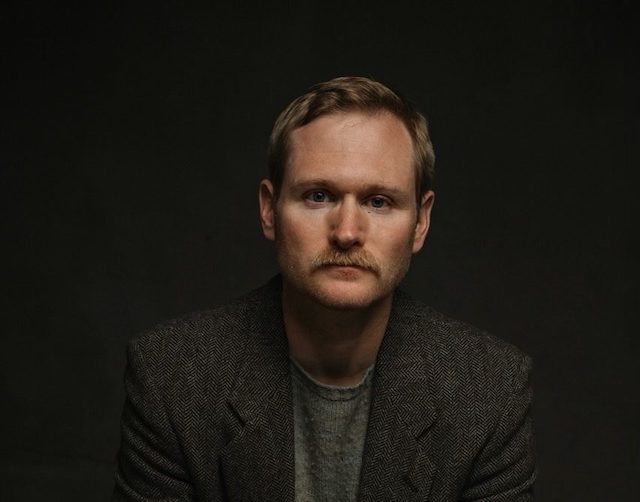
Wise grew up in Virginia and has degrees from the Virginia Military Institute and the University of Mississippi’s M.F.A. program. He writes in multiple genres, including poetry, and there’s a lyrical cadence to his sentences. His unique style earned him plenty of accolades for Holy City, including the Edgar Prize for Best First Novel. Promised Land is a worthy follow-up, further cementing Wise’s reputation as a force in gritty, Southern crime fiction.

Erica Wright‘s latest books are The Museum of Unusual Occurrence and A Buyer’s Guide to the Afterlife. She lives with her family in Knoxville.