A World Full of Sadness and Goodness
Rebecca Rose Mooradian’s debut picture book was inspired by her great-grandmother’s escape from genocide
Beginning in 1915, an extended campaign of mass killing and ethnic cleansing was carried out against Armenians in the Ottoman Empire, ultimately resulting in hundreds of thousands of deaths. The years-long massacre would become known as the Armenian Genocide. The lawyer who coined the term “genocide,” Raphael Lemkin, first began developing the concept after learning about this atrocity.

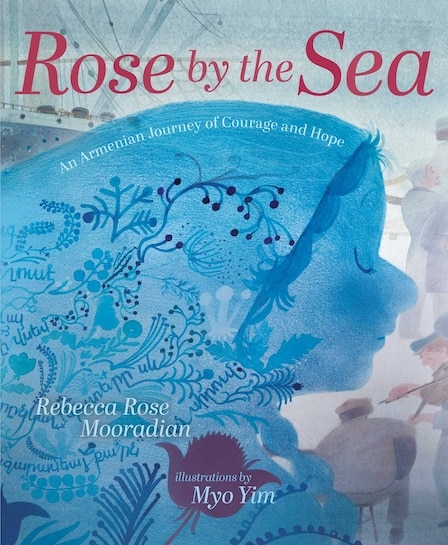
Nashville-based author Rebecca Rose Mooradian’s debut picture book, Rose by the Sea, tells the story of her great-grandmother Dzovinar’s escape from Armenia during the genocide. The book follows Dzovinar and her older sister as they hide in a Turkish woman’s home and eventually make their way by boat to France, then to the United States. Though genocide is a difficult topic to center in books for young children, Rose by the Sea is a gentle, lyrical read, with soft, warm illustrations by artist Myo Yim.
Rebecca Rose Mooradian answered questions from Chapter 16 by email.
Chapter 16: How did you first learn of your great-grandmother’s story?
Rebecca Rose Mooradian: I can’t remember a time when I didn’t know the story, though much of how I came to think about Dzovinar surviving the Armenian Genocide came from an article my father, Don Mooradian, wrote when he was working as a columnist for the Daily Herald in Columbia, Tennessee. In that article, “Let’s forget old hatreds,”— which was published just shy of my 6th birthday — he discusses not only the stark and horrific parts of Dzovinar’s story, but ultimately the hopefulness of her having been helped by a Turkish family. I think that frame is still the heart of this book.
Chapter 16: Based on your author’s note, it seems like you changed some aspects of your great-grandmother’s story for this picture book. Why did you make those changes?
Mooradian: Picture books are a beautiful art form because there are so many constraints! Tell a full story in 1,000 words or less! Paring a tale down to its most essential parts is challenging, but I knew I wanted to focus on Dzovinar’s courage, her bravery, her determination to keep going. That meant consolidating other aspects of her story.
Chapter 16: Why did you feel called to tell Dzovinar’s story now?
Mooradian: I actually wrote this story in an afternoon back in 2020. It was a couple of years before my then agent felt it was the right time to put it out on submission, and then it took several more years for illustrations and everything else to be finalized!
But the story does feel especially timely now. I think it is so important we acknowledge the bravery and courage it takes for immigrants to come to our country, as well as the hardships that lead so many of them to decide to do so. Hopefully this story can help young readers empathize with immigrants.
Chapter 16: Was it difficult to write about genocide in a way that would speak to young children?
 Mooradian: As a mom, I feel tension between wanting to protect and shelter my children, while knowing how important it is to raise informed citizens who recognize how fortunate they are and who know and understand their family history. This carries over into writing for young readers. The known facts of Dzovinar’s story are that of 11 siblings, only 4 survived the Armenian Genocide. That didn’t feel like an appropriate fact to include in the book. What feels most significant for kids to understand about the genocide and other similar atrocities is that people did die. But also that many people, including children, had to escape and survive and be brave. They had to take great risks and trust the goodness of others.
Chapter 16: The text is beautifully rooted in sensory elements, with color as a frame. How did you come up with the idea to center color in this way?
Mooradian: The line “Rose is the flower by our kitchen door” began rattling around in my head and ultimately helped shape the rest of the book. I think memory — especially traumatic memory — often latches on to smaller, lesser details. It’s a safer way of remembering without focusing on the entire gravity of a moment. It felt important that as the story progresses, the colors darken before returning to brighter hues, and then eventually there is an integration of all the colors as Dzovinar is able to bring memories of her past with her into a more hopeful future.
Chapter 16: Likewise, Myo Yim’s illustrations are so warm and soft. Do you have a favorite page spread?
Mooradian: Oh my goodness, I’m obsessed with Myo’s illustrations and couldn’t possibly pick one! They are beautifully detailed and provide so many moments of whimsy and heart and gentleness. I think my favorite subtle detail comes when Dzovinar and her sister huddle together in the desert; their shadows are actually the shadows of their parents, watching over them. It always brings tears to my eyes. I also love Myo’s use of Armenian Trchnagir calligraphy — a unique calligraphy art that uses birds — which she has woven into Dzovinar’s hair. That spread became the cover of the book.
Chapter 16: What do you hope children take away from reading this picture book?
Mooradian: When I heard this story from my father as a child, my main take-away was, “Oh my gosh, my great-grandmother crossed the desert to come to America. I can study for this spelling test. I can learn to ride a bike. I can audition for this play.” We’re all capable of doing hard things, of stepping up and facing seemingly impossible challenges. That’s not to minimize the real and valid anxieties we all face daily, but it can help put them into perspective.
I also do hope they’ll remember that a Turkish family hid my great-grandmother from the Turkish army. Dzovinar would not have survived if they hadn’t done so. I wouldn’t be alive today. The world is full of so much sadness, but more than that, it’s full of goodness. It’s full of love.
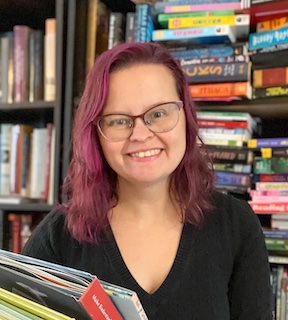
Margaret Kingsbury is the “Hey Nashville” newsletter writer for City Cast Nashville. Her book reviews have been published in Book Riot, BuzzFeed News, StarTrek.com, School Library Journal, IGN, and more. Her debut picture book, A Breath Between Leaves, will be published in 2027 from Groundwood Books. You can find her on Instagram @BabyLibrarians.