Broke-Down Blessing
Donovan McAbee savors the complexities of the spiritual life in Holy the Body
In “Coming Back Down,” a poem from Nashville poet Donovan McAbee’s Holy the Body, the speaker reflects on an early encounter with a mesmerizing “storefront church” preacher. He questions why this preacher sought him out from the crowd for a tongues-speaking spell, sending him to the floor as a “lonesome gospel lifted me somewhere.”
“Maybe I looked an easy target,” he considers, “or maybe he read on my face the signs / of someone in need of a good dose of wonder.” Either way, the moment left him overcome by “the beauty of it all.”
Holy the Body brims with depictions of the spiritual life that refuse dogma or sentimental cliché. These poems savor small, closely observed moments of wonder and beauty, prized for their complexity and nuance.
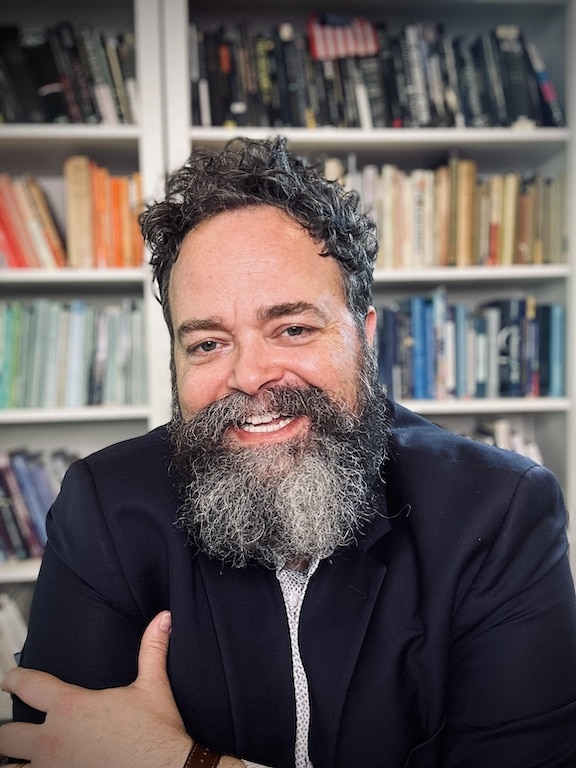
A South Carolina native, McAbee currently works at Belmont University as associate professor of religion and the arts. You know a book will appeal to Nashville readers when it opens with an invocation of the legendary Nun Bun. From its sudden appearance in a coffeeshop cinnamon bun, the face of Mother Teresa “looked serious, perturbed even, as though / this epiphany were an inconvenience.”
This image presides perfectly over these poems, which often favor sweet experiences that also harbor darker elements. “Sister Evangelyne,” for example, gives us an ecstatic portrait of a woman mid-worship, “heels hammered against / the sanctuary’s wooden floor.” She “spoke in tongues too strained to understand, / rattled off accusations at angels, doxologies / in a minor key.” Elsewhere, a beloved, ailing grandmother enjoys her final cigarette as “last rites.”
The quick, sharp “Hamstrung” finds its speaker in a thornier tone of spiritual experience: “I caught a parable and threw it back. / Like hay in a needle-stack / I’ve kept my ointment in a jar of flies.” This tone continues in “Swallowing the Camel”: “My faith is a gnat, / my devotion a polished / stone, my fears / a dog whimpering.” In times of struggle, waiting for response from the sacred world is “like the feeling you get / in the family room / at the hospital when / someone you love / goes under the knife.”
 This incisive image sets up a sequence of poems focused on the speaker’s parents and the arresting moments in family relationships that accompany health crises. A multi-sectioned poem shows the speaker’s mother breaking hurtful patterns even as she confronts a grave illness. The moments described become transformational for both her and her son. Her life offers “a miracle worth pondering: // an unloved woman / learned to love. // You made water from thirst, / bread from hunger.”
Next comes a sequence of poems that follow the son’s experience of his father’s sudden health emergency and the brutal process of lifesaving measures being performed. In broken lines, the speaker of “Breath” recalls his father’s face suddenly gone still, “staring out to where / form collapses.”
“Delirium” is a disorienting passage into the foreign terrain on the other side of that trauma, as the son watches his father “come back like Lazarus.” “Spirit” relives the moment he begins to give his father chest compressions, recalling “the breathlessness that / signals thought fleeing the body to // make room for sheer action.”
The latter sections of Holy the Body delve deeper into the embodied nature of our spiritual selves. These poems edge closer to mystical reflections, as in “The Prayer That Leads into Darkness”:
An empty room with no door
down a hallway without wallsThe answer to a riddle
no one knows to ask.
In other words, our lives are filled with irresolvable paradox.
McAbee highlights material objects that suggest spiritual questions. A one-eyed, one-handed flea market Jesus statue captures the attention of a speaker who is drawn to its worn-down looks and signs of some long, unknown history. But in a different poem, a homeowner offers up a whole list of storied objects to imagined burglars. Shedding them would lift a burden of earthly attachments — in his thoughts, at least.
McAbee also weaves levity into many of these poems. In one, a vision of angels (“the messengers of your making”) offers ice cream as an elixir to summon the words that reveal a life’s mission. A prose poem imagines the speaker’s hangout with Jesus, complete with a round of “your mama” jokes. “Desert Sayings” mingles wisdom from the early Christian church’s Desert Fathers and Mothers with doses of contemporary absurdity. Same goes for “Cumberland Koans,” which lists brief reflections edged by good-humored humility.
The collection’s title poem finds its speaker addressing a moment of humbled reckoning with his mortal, physical self, “so long neglected”: “I bless our breaking down, dear body, / pray the process is slow, that when time / confronts us with its choices, you’ll teach me / when to hold on, when to let go.”
Holy the Body depicts a restless faith awake to all the perilous truths of our age, the paradoxes woven into our humanness, the finiteness of our lives. And the lens through which McAbee offers us these subjects is always beauty. Beauty found in both the ineffable and the material realms.

Emily Choate’s fiction and essays have appeared in Mississippi Review, storySouth, Shenandoah, The Florida Review, Rappahannock Review, Atticus Review, Tupelo Quarterly, and elsewhere. She holds an M.F.A. from Sarah Lawrence College, served as one of the founding editors of Peauxdunque Review, and lives near Nashville, where she’s working on a novel.