Dignity in Receiving, Kindness in Giving
The Yellow Postcard explores child food insecurity with hope and joy
Hunger affects many Tennessee children. More than 36% of Tennessee families experience food insecurity. Yet only a handful of picture books center the issue, and few, if any, depict joy in the same way Savannah Allen’s newest book, The Yellow Postcard, does.

Allen, a Nashville-based author and illustrator whose previous picture books include Broccoli Is Trying to Kill Me and The Nature Journal, was inspired by her own experiences when writing The Yellow Postcard. “While I benefited from free lunch and community boxes, I was filled with humiliation and tried to do everything I could not to be noticed as I accepted help,” she explains in a note at the end of the book. Instead of highlighting that shame in The Yellow Postcard, Allen imagines a “what-if” scenario where a community comes together to celebrate the joy of sharing amid food insecurity. Savannah Allen answered questions from Chapter 16 by email.
Chapter 16: Taylor is SO happy about picking up her food box. While I know of a few picture books about food banks, this is the first one I’ve read that centers joy. Why was that important to you?
Savannah Allen: I wrote The Yellow Postcard in 2023, during a time when conversations about SNAP and other food assistance programs felt especially negative. While there have always been open discussions where receiving food assistance was unfairly judged, the criticism felt much louder than I had ever experienced in my lifetime. As I listened, I found myself thinking about how those conversations would have made me feel as a child. And it wasn’t good. During that time, I decided I wanted to add a joyful voice to the discussion — especially for the children who don’t get to choose their circumstances.
When people debate food assistance, children are often at the center of those conversations — 1 in 5, in fact. The words we use shape how they feel about receiving help and how they view others who need a helping hand. Every child deserves to know that needing support is never something to be ashamed of.
The Yellow Postcard was written to help combat the stigma surrounding food assistance programs and to celebrate something much bigger: receiving help, giving help, community, and family. My hope is that every child who reads the book walks away knowing that asking for or accepting support doesn’t diminish their worth — it reminds us that we all need one another sometimes.
Chapter 16: One thing I loved about this picture book is its focus on community. Was that aspect there from the beginning? What did you hope to say about community and its significance in terms of food insecurity?
Allen: YES!! Community was always at the center of The Yellow Postcard.
When I created Taylor’s community, I wanted every page of the book to include someone offering a helping hand and someone receiving one. It was important to me that readers see both sides of community, that there is dignity in receiving help and kindness in giving it. Neither role is greater than the other. They’re both part of what makes a community strong, and over the course of all of our lives, we’ll likely find ourselves on both sides.
We also live in a time when we consume endless information and headlines without much human connection. It’s so easy to form judgments about people we’ve never met. But food insecurity is a deeply human issue that requires empathy, compassion, and understanding. It is much easier to channel that when we know our neighbors and show up for one another.
Chapter 16: Your previous picture books cover topics like killer broccoli, nature journaling, and adventurous cupcakes. Did tackling the more serious topic of food insecurity in The Yellow Postcard impact your writing and illustrating?
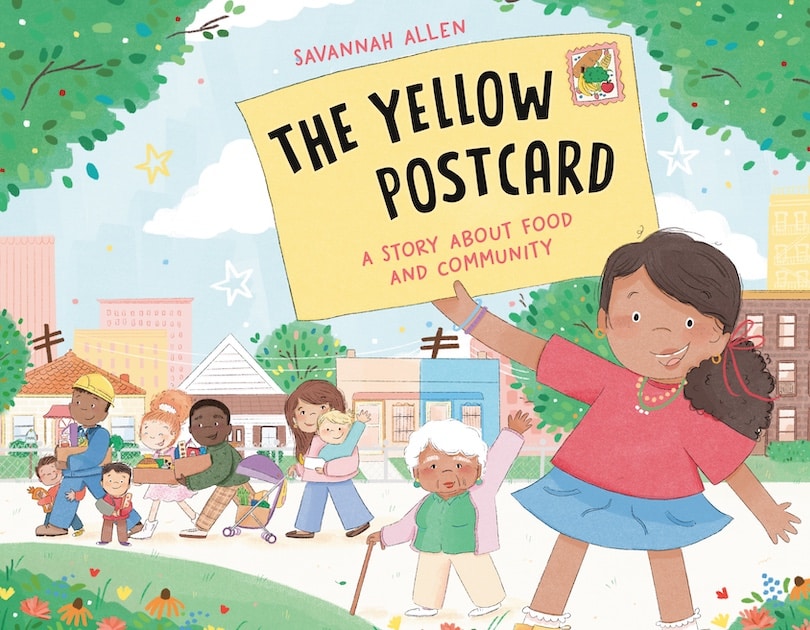 Allen: This made me laugh because it’s true! Going from making carefree, lighthearted books to telling a more intentional story was incredibly challenging. As an illustrator, I could clearly picture what I wanted every page to look like. But as the author, I wasn’t sure I could capture the heart of the story in the way it deserved.
My art naturally leans toward cute, and there were moments when I seriously considered asking another illustrator to bring this book to life because the topic felt so meaningful and attempting to illustrate felt so overwhelming. I wasn’t sure I was the right person to do the job even though it was my story to tell.
I’m so grateful I stuck with it. Every spread contains pieces of my own story and moments that are deeply personal to me and my family. I’m proud that I challenged myself to write about a subject that mattered so much to me, but I’m even more proud that I trusted myself to bring those moments to life through the illustrations as well.
Chapter 16: How does the process differ when you’re both the author and illustrator of a picture book compared to when you’re the illustrator working with a different author?
Allen: Great question! Writing and illustrating a book at the same time is definitely a different beast.
When you’re illustrating someone else’s manuscript, your job is to make sure the art supports and expands on what the author has written. In some ways, it’s easier because there is only so far the art can go. You’ve been provided the story, and your creativity and imagination have a clear direction.
But when you’re both the author and the illustrator, there are no brakes. The story can become anything at any moment, which is both exciting and incredibly overwhelming. Every word influences the art, and every illustration can change the way you think about the words, and every memory can kickstart a change in wording, and then you’re in a cycle. It’s a rewarding process, but it can also lead to a lot of overthinking and perfectionism!!
Creating a book that’s this personal requires vulnerability in every aspect. Thankfully, I had incredible people in my corner who kept bringing me back to the heart of the story. How wonderful community is!!!
Chapter 16: I saw on Instagram that you have a food drive initiative paired with the release of The Yellow Postcard. Can you tell us about it and how people can get involved?
Allen: Yellow Postcard Day is a community initiative that brings people together through food. It’s a fun, interactive way for readers of all ages to become part of a (hopefully soon) nationwide community while supporting their local food pantry.
On the 1st and 15th of every month, I check the Yellow Postcard Day P.O. Box (address below) for letters, postcards, and notes from readers sharing their favorite food.
Then the fun begins! I read their cards and then donate each sender’s favorite food to their local food pantry, so they can follow along and see where their favorite foods end up helping people in their own community and/or if they have the same favorite food as someone else.
Yellow Postcard Day celebrates the many ways food brings us together. It introduces families to local food banks and pantries, highlights the important work they do, and makes it easy for anyone to take part! Since most food pantries rely on donations and have ongoing wish lists of needed items, every postcard helps raise awareness while encouraging communities to support one another.
So grab a postcard, tell me your favorite food, and join the celebration!!
Sav Allen or Yellow Postcard Day
P.O. Box 40091 Nashville, TN 37204
Margaret Kingsbury writes the City Cast Nashville newsletter. Her book reviews have been published in Book Riot, BuzzFeed News, StarTrek.com, School Library Journal, IGN, and more. Her debut picture book, A Breath Between Leaves, will be published in 2027 by Groundwood Books. You can find her on Instagram @KidLitMatters.