Reckless Awe
Jeff Hardin’s latest poetry collection meditates on nature and art, finding wisdom in the quietest moments
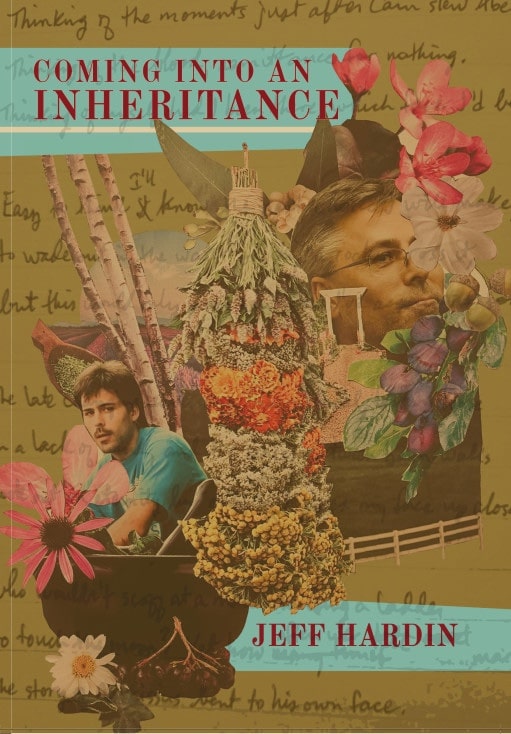
Jeff Hardin’s latest poetry collection, Coming into an Inheritance, offers a balm for our chaotic times. These poems convey the grace of nature and power of art, as quick to praise a wren in a dogwood tree as the paintings of Vermeer. They are generous, contemplative works that abound with earned wisdom.

In “Since Possibility Is Aesthetically Higher Than Reality,” Hardin writes,
Poets keep insisting on a single moment, as though
its worth outweighs the others, as though we get just
one and not this long succession adding up to more.
These lines could be a description of this book’s project, with memorable moments accumulating into something even more meaningful. In meticulous tercets, Hardin evokes pastoral settings and acknowledges great minds in literature such as Issa, Dickinson, Milosz, Rilke, Plato, and more. The effect is a much-needed reminder that some pursuits are timeless and we would do well to turn off the modern noise. Without making a big fuss over the argument, Hardin shows us the enduring potential of writing to make us slow down, consider, and appreciate our surroundings.
In some ways, this collection begins with an unspoken argument. The first poem, “Taking on Other Voices,” assures us,
That some will take on voices, imagining lives
not their own, in times they never knew, must
mean a tenderness still moves within the world.
The lines imply there must be others out there arguing that tenderness is extinct, that our world now runs on violence. Hardin posits that the existence of artists proves the opposite.
Hardin is a poet who wanders over landscapes, through history, and among ideas. In “A Few Words Left Behind,” he writes, “I could spend all evening / staring at two trees at the far end of this snow-soaked field.” And this statement rings true. Hardin seems to have an uncanny amount of patience.
 Of course, he might object to this characterization. Despite the overall calm tone of this collection, hints of defiance creep into the work. In “A Word That Means What Separates Us from Our Souls to Come,” Hardin writes, “It’s not enough to know the afterlife is coming next. / I want, right now, to know the knowing I’ll know then.”
This relatable sentiment comes from a sequence that highlights poetry’s unique ability to give us language for emotions and experiences beyond pedestrian communication. The section “Another Language” includes 12 poems beginning with the phrase “A Word That Means…” Examples include “A Word That Means How Each Moment Offers a Sermon” and “A Word That Means How I Have Lived Awhile Longer.” There’s a wry humor in this project because there are no words for these situations, hence the need for poems about them.
Despite his impatience with knowing what comes after death, Hardin often practices what John Keats deemed “negative capability.” Keats wrote in a letter to his brothers that a genius writer is someone who “is capable of being in uncertainties, mysteries, doubts, without any irritable reaching after fact and reason.” That is, someone who’s comfortable asking questions that might not have answers. Hardin makes this challenge look easy. All one must do is spend a lifetime meditating on a hay bale, a sculpture, or the like.
This occupation leads to another experience in short supply these days: awe. That is, the sublime feeling of a natural phenomenon being so grand (so awesome) that we humans feel rightly humbled. In this collection’s final poem, “Point of Origin,” the speaker describes a purple sky after a rainstorm, then doubles down on that description: “So what if I exaggerate — I do so out of reckless awe.”
Hardin was born in Savannah, Tennessee, and his poems are rooted in recognizable Southern landscapes. He recently retired after teaching for many years at Columbia State Community College, and his previous collections include the award-winning titles Restoring the Narrative and No Other Kind of World. A theme of gratitude runs through his life’s work, and readers might find the sentiment contagious.
“I’ll take what light I find wherever it stalls the dark,” Hardin writes in “A Fire We Might Touch.” So much of this poem’s impact hinges on that sharp word “stalls.” Despite its hopeful tone, this is not a collection that denies humanity’s struggles and suffering, but rather a collection that acknowledges art’s potential to offer a respite. A pause not a stop. Readers of Coming into an Inheritance might find themselves uplifted for a spell or at least more inclined to appreciate the swoop of an owl outside their windows.

Erica Wright‘s latest books are The Museum of Unusual Occurrence and A Buyer’s Guide to the Afterlife. She lives with her family in Knoxville.