Thinking Of, Feeling With
Mark Mayer’s About, Above, Around proposes 50 ways to have fun with prepositions
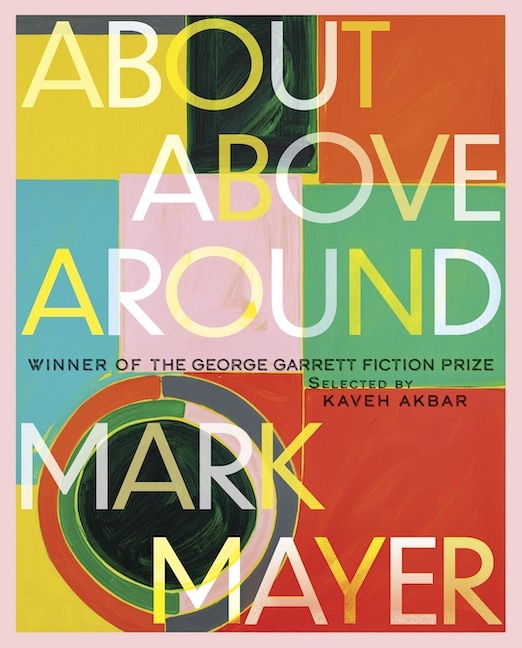
Lovers of literature tend to be devoted to language — the power of verbs, the structure of nouns, the music of adjectives — but too often the humble preposition gets overlooked. Mark Mayer hopes to rectify this injustice. In his new story collection, About, Above, Around: 50 Prepositions (winner of the 2024 George Garrett Fiction Prize), Mayer deftly depicts the facility of that marginalized part of speech to burrow into our minds, connect ideas across dimensions, and resituate us in reality.
 Never again will you stand idly by as an over-inflated language maven pontificates against ending sentences with prepositions. They shall forthwith receive pride of place, Mayer insists, and you shall hearken their voice.
The opening chapter of Mayer’s collection announces at once the book’s grounding principle: “Physics is still learning what gives space space and time time, but from the point of view of language, prepositions are what hold together, arrange, and shape these reaches.” This chapter, helpfully called “About,” goes on to clarify the collection’s premise and method: “If the prepositions are the body’s inborn language, can they describe its native ruckus? That is the hypothesis. These half-invisible words track emotion’s half-invisible maneuvers. These stories are the experiments.” My advice: listen in and buckle up.
The ensuing 49 sections, each devoted to a preposition (with four repetitions of “About”), range broadly in variety of subject matter, narrative voice, and philosophical interests, though motifs recur. The most frequent narrator is a youngish Jewish man (sometimes named Mayer or M—) who is fixated on a sister (Mimi, Marnie, Mandy), who creates problems the protagonist struggles to solve. In “Near,” the intimacy between siblings melds their identities: “Gus ought to know that her true and precious but also flimsy, makeshift self, whatever it was made of, could affix only two places in the universe: in her own body and next to his. If she lost her body, she could live like a rash on him.”
 Mayer returns to Jewish motifs throughout the collection, starting with the number 50, which represents the number of days between the Exodus and the revelation of the Torah on Mt. Sinai. At Hebrew school, an adolescent narrator studies a poster with “fifty expressions of a young male cartoon face” that correspond to 50 different moods. That character rebels against his indoctrination, telling his mother, “I don’t believe in God.” After some moments of scrunching her scarf, the mother responds, “Sounds smart.” Other stories meditate on the correct pronunciation of the name of God — which, by tradition, is to be avoided — and the usefulness of a yarmulke to hide a bald spot. “You don’t need to believe in God to feel better with a cap on,” Mayer writes.
Mayer focuses on the physicality of language: the space it occupies on the page, the shape of our mouths when speaking, the breath needed to create meaningful sounds. A character called Milkbaby gets lost in the woods and calls out for his friend Jeffo, “Jeffooooo … ” and so on, for 37 o’s, until the o’s “tangle” around Milkbaby and he starts suffocating on his own words: “It is hopeless now, how the o’s enweb him, but he keeps calling because his dumb heart will not stop.”
In their willingness to tackle fundamental questions, Mayer’s stories evince simultaneously a childlike wonder at life’s mysteries and a mature reflection on identity. Sometimes, Mayer accomplishes both in the same passage: “All children are foreigners, for they must learn life’s customs, and they do, they learn them masterfully. They hold their hands behind their frock coats and turn on their heels and wonder, wonder not just philosophically, how it is they lost, or never had, a native land.”
As playful and downright zany these stories are, Mayer finds ways to slip in observational gems and Joycean epiphanies. In “Atop,” Margot goes on an Outdoor Leadership Training backpacking trip that culminates in summiting Mount Moot, an experience that underscores human ephemerality: “Margot could see everything from here. She would know what had been possible behind Mount Moot; she would always at least still know what it was that had had to end.” In “Onto,” Maud learns that a sense of belonging to a place emerges only in retrospect: “In the present tense, home was impossible. But having had one, you could hope to again.”
The large quarto format of About, Above, Around will remind mature readers of Douglas Coupland’s Generation X. Mayer’s collection includes 18 paintings from Jason Stopa, full-page, abstract, colorful works that provide readers an aesthetic pause in the verbal gymnastics. This collection also recalls innovative fiction from Joshua Cohen (Witz, in particular) and Jonathan Safran Foer (Here I Am, the Abrahamic declaration that Mayer echoes here). But in the end, Mayer’s bite-size narrative nuggets create a genre of their own, ambiguous ruminations on/with/inside language that enrich our conceptual lexicon.

Sean Kinch grew up in Austin and attended Stanford. He earned a Ph.D. from the University of Texas. He now teaches English at Montgomery Bell Academy in Nashville.