This Little Piggy …
Mark A. Johnson chronicles America’s love-hate relationship with bacon
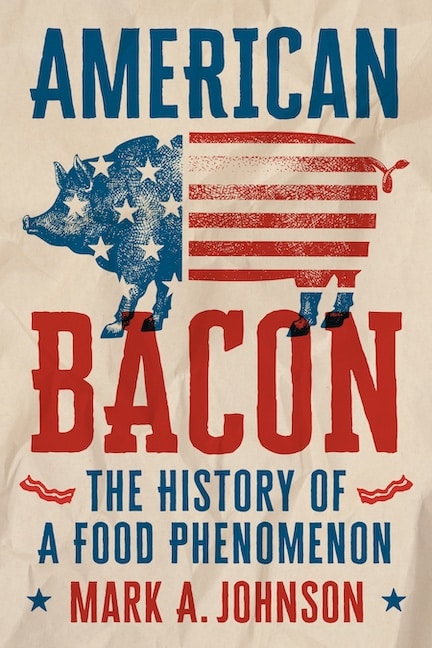
For the last two decades bacon has seemingly been everywhere. And not just in food form. Whether stickers, wrapping paper, socks, perfume, ice cream, or a myriad of other products, bacon as image, scent, and taste pervades the American marketplace. How did this come to be? In his new book, American Bacon: The History of a Food Phenomenon, Mark A. Johnson, who teaches history at the University of Tennessee at Chattanooga, recounts the saga of one of our country’s favorite and most controversial foods.

Johnson readily acknowledges that bacon is not a uniquely American food. Pork, including the cuts a modern consumer would recognize as bacon, has formed an important part of the human diet since prehistoric times. Methods for curing and preserving this meat have been used in China since about 1500 BCE and in Europe since Roman times. Pigs were brought to North America by the Spanish in the 1500s, and the English brought them to their new colonies in the early 1600s, the period in which Shakespeare wrote about “bacon fed knaves” in Henry IV. American Bacon includes this pre-colonial history but, as the title suggests, it primarily details how bacon became part and parcel of the American experience. Johnson, whose earlier work includes An Irresistible History of Alabama Barbecue, describes his new book as a history of how “bacon transitions from mundane staple to culturally backward and poverty food, then to dietary threat and finally pop culture icon and gastronomic phenomenon.”
As part of our nation’s history, bacon has naturally reflected that history’s economic and cultural development and divisions. One of Johnson’s themes is how views of bacon have evolved as the country progressed from colony to nation, rural to urban, slave owning to free, and as our diet grew from subsistence to culinary snobbishness. His chapters demonstrate how the nation’s growth altered bacon’s place in our lives. “From tastemakers to consumers,” he writes, “Americans put bacon into their meals and their conversations about health, wealth, status, civilization, race, and gender.”
 One of the many aspects of bacon’s historical relevance Johnson explores is its relationship to slavery. Bacon was an important part of the slave economy. In antebellum times there was debate in Southern agricultural journals about how much bacon to allot the various classifications of enslaved people — field hands, craftsmen, or domestic workers. The most common recommended ration of bacon for Southern plantations was three and a half pounds per adult per week, a subsistence level more typical of frontier life.
With the coming of the Civil War, the Union and Confederacy both realized that bacon would be key to nourishing their armies and the fight over slavery became, in part, a struggle to supply a ration of five and a quarter pounds per soldier per week. The South could rarely provide this amount, largely because the Union had cut off supplies from Kentucky and Tennessee, two of the principal pork-producing states.
Through the 20th century, bacon was alternately regarded as a poor person’s food or a patriotic dish that could extend scarce supplies of meat during the world wars. With the rise of nutritional and medical science, bacon was regarded as unhealthy, a cause of heart disease and obesity. In the 1970s, banning bacon as a potential carcinogen became a real possibility. The threat passed but, as Johnson notes, “Although producers, consumers, and scientists continue to debate the extent to which nitrosamines pose a threat, bacon and cancer remain linked.”
Then came the popularity of protein-rich diets in the late 20th and early 21st centuries. Farm-to-table marketing, culinary experimentation, and a cultural backlash against government-decreed dietary standards also contributed to a newfound love for a historically stigmatized, if important, meat. “Bacon mania” had arrived, and by 2013, Johnson notes, “65 percent of Americans favored making bacon the ‘national food.’” The craze brought the rise of artisan bacon and Johnson helpfully includes a section on the various available brands of that specialty meat. As demonstrated in American Bacon, a book likely to be regarded as the definitive work on the subject, our love-hate relationship with bacon will likely continue long into the future.

A Michigan native, Chris Scott is an unrepentant Yankee who arrived in Nashville more than 35 years ago and has gradually adapted to Southern ways. He is a geologist by profession and an historian by avocation.